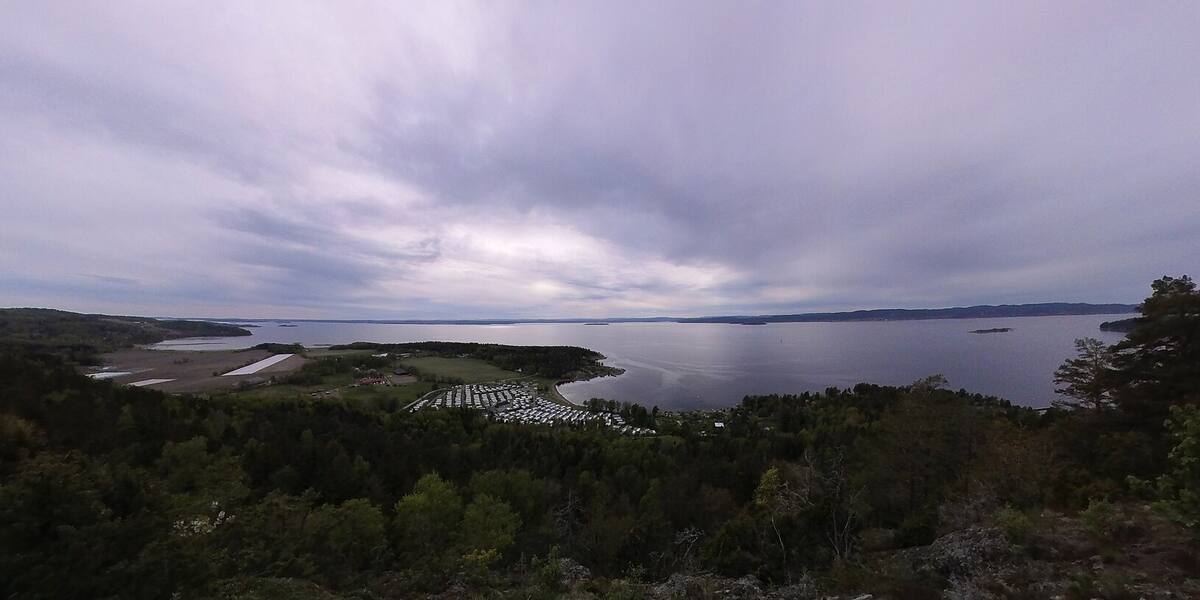
Photo: Sebbog13·CC BY-SA 4.0· Wikimedia Commons
Islands / Moss / Jeløya
One of the largest islands in the outer Oslofjord (about 19.7 km²), cut off from the mainland when Mossekanalen was dug in 1855. Known for its manor landscape (Alby, Reier, Grimsrød), the art centre Galleri F 15, its links to Edvard Munch, an unusually rich flora, walking trails and beaches such as Tronvikstranda and Sjøbadet (Blue Flag). The west side drops into the sea at Rambergnebba.
Jeløya fills most of the horizon on the way in to Moss from the fjord: ten kilometres long, four across, the largest piece of land in this part of the outer Oslofjord. The west side is the dramatic one, where Rambergnebba rises in sheer cliffs straight out of the water with Rambergåsen at 140 metres behind. Refsnes and the bathing rocks come into view along the same coast.
several nature reserves and landscape protection areas on the island, among them Nordre Jeløy landscape protection area. The boundaries and the rules are in Naturbase, and they are worth checking before you land anywhere outside the marked areas.
road bridge from central Moss.
The island is connected by road, so you need neither a boat nor a timetable.
Jeløya is strictly speaking a peninsula. It held on to the mainland by a narrow isthmus of moraine from the Ra, the large ice-marginal deposit that crosses Østfold. On 6 November 1855 Mossekanalen opened, a ditch 20 metres wide cut straight through the isthmus, and the peninsula became an island. A rolling bridge crossed the canal first, then a swing bridge, and from 1957 a bascule bridge. The bascule mechanism was welded shut in 1975, and the bridge no longer opens for masts.
The bedrock is Permian lava, part of the Oslo Rift (*Oslofeltet*), with rhomb porphyry at the surface. Fossil-rich Cambro-Silurian limestone comes through in the lower ground. That lime-rich soil gives Jeløya the unusually rich flora it is known for among botanists.
Jeløy was a municipality of its own until it was merged with Moss in the 1940s. The island carried a row of manors: Reier, Alby, Grønli, Torderød, Kubberød, Grimsrød and Orkerød, laid out on the good soil by the merchants and officials of the town. Edvard Munch lived at Grimsrød during the First World War. Alby farm became the home of Galleri F 15 in 1966, founded by Lars Brandstrup as the first art centre of its kind in Norway. The name came from the gallery's first address at Fossen 15 in Moss. It is run today by Østfold county together with several municipalities, and it hosts the Momentum art biennial. The Refsnes manor became a hotel, Refsnes Gods.
Jeløya has around 11,000 residents and is a residential area just outside the centre of Moss, while the northern half is set aside for farming, forest and outdoor life. People come for the beaches, the art at Alby and the walks through the manor landscape. Grazing animals keep the farmed landscape open in the protected area to the north.
Jeløya is reached by car across the bridge from central Moss, with no ferry involved. From the water you can land at several of the beaches. Sjøbadet and Tronvikstranda are both Blue Flag certified, and Sjøbadet has held the label since 2012. There are also Fiskestranda, Albybukta, Bredebukt, Reierstranda and Refsnesstranda. Nordre Jeløy is a landscape protection area (*landskapsvernområde*). Walking is allowed, but this is a protected farmed landscape, so respect the grazing animals, the fences and the fields. Check Naturbase, the national database of protected areas, for the smaller nature reserves before landing anywhere fragile.
Rambergnebba is where local teenagers jump. The cliff has take-offs at several heights, 6, 8, 15 and a full 21 metres, about a kilometre north of Refsnesstranda. The 21-metre jump is not for everyone.
Munch painted on Jeløya during the war years, at Grimsrød farm. Galleri F 15 opened at Alby, another of the manors, in 1966.
The bascule over Mossekanalen was welded shut in 1975 and has not opened since. Jeløya had been an island for 120 years, and is land-connected in practice again.
The lime in the Cambro-Silurian ground feeds the flora. Botanists come for species that grow nowhere else in the district.
Oslo Sea Experience passes Jeløya on its private fjord trips from Tjuvholmen.
The Norwegian version notes which facts were taken from each source: Jeløya på norsk.