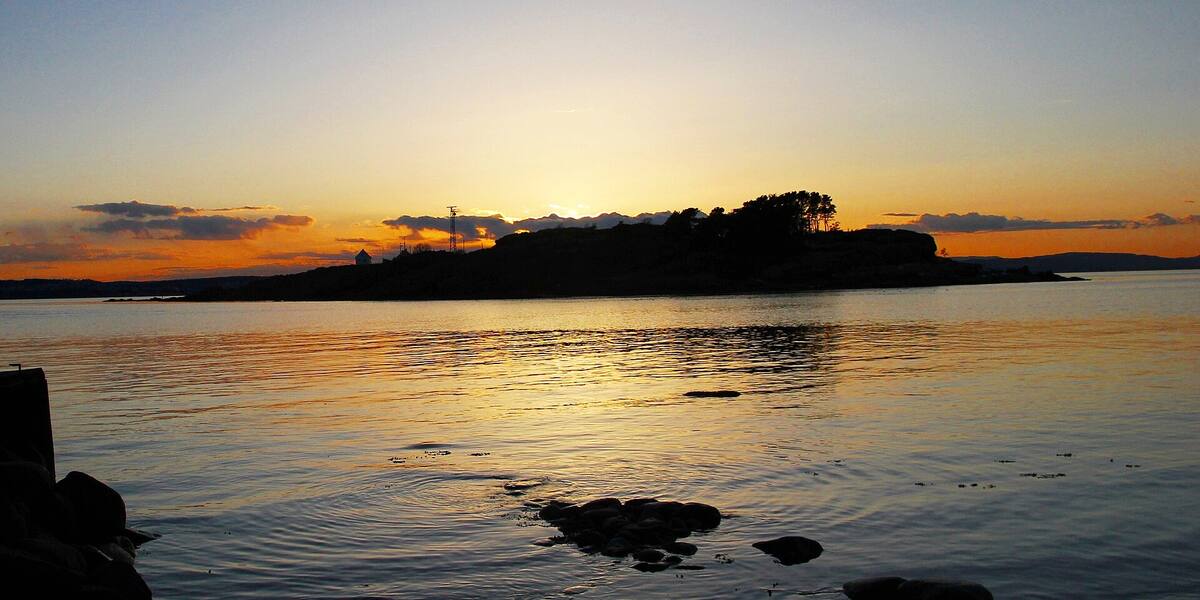
Photo: GisleHaa·CC BY-SA 3.0· Wikimedia Commons
Islands / Moss / Gullholmen
A small island west of Jeløya with Gullholmen lighthouse, first lit on 15 September 1894 and automated in 1984. It is the westernmost point of Østfold. The foundation Stiftelsen Gamle Guldholmen Fyr restores the historic buildings, and the island belongs to the coastal trail system (*kystleden*), where a night can be booked.
Gullholmen sits just west of the southern tip of Jeløya. You see a cluster of low station buildings in white and red, and in front of the old lighthouse stands an 8-metre fibreglass tower. From the northeast it is straight ahead of you, with the approach to Moss behind.
Part of Kystled Oslofjorden. See all the coastal trail cabins.
Coastal cabin, bookable for the night / own boat or kayak.
No scheduled boat comes here. You will have to find the nearest public quay yourself, and the rest is your own boat or a kayak. Check the wind and wave forecast before you set out. The open stretches in the outer fjord turn unpleasant in a fresh breeze.
The case for a light here was examined in 1891. The Oslofjord was being lit more densely in those years for the growing shipping traffic into Kristiania and Moss. Funding came in 1893–94, and the light was first lit on 15 September 1894. The original tower was 8.2 metres tall.
The station was staffed by a lighthouse keeper who lived on the island with his family. Shortly before 1940 the staffing was expanded with an assistant keeper, and a new family house had to be built to fit everyone. Six buildings remain today: two dwellings, two outbuildings, a machine house and a boathouse.
The light was electrified in 1930 with power from the municipality. In 1984 it was automated and the crew withdrawn, as at most Norwegian lighthouses that decade. In 1989 ownership passed from the Norwegian Coastal Administration (Kystverket) to the Directorate for Nature Management. A ground lease was signed the same year with Stiftelsen Gamle Guldholmen Fyr, which has handled restoration and operation since. A radar installation for the traffic centre at Horten was added in 1999. Gullholmen has been part of the Oslofjord coastal trail system since 2015.
Stiftelsen Gamle Guldholmen Fyr restores and maintains the historic buildings, and all rental income goes back into conservation. The light itself is state property and runs automatically from the fibreglass tower. The island is a coastal trail cabin (*kystledhytte*): guests can rent the keeper's house for the night through Oslofjordens Friluftsråd, an arrangement in place since 2015.
Gullholmen is reached by your own boat or kayak. No scheduled boat runs here. Overnight stays are booked through the coastal trail system of Oslofjordens Friluftsråd, with the letting handled by the foundation. The radar for the Horten traffic centre is serviced independently of visitors. No access restrictions are registered on the island itself, but the buildings are under private lease and in daily use, so treat them accordingly. Check Naturbase, the national database of protected areas, for bird protection on the neighbouring skerries before you come alongside.
The old lighthouse no longer shines. Since the station was automated in 1984 the light has come from the fibreglass tower planted right in front of the masonry building.
Gullholmen is the westernmost point of Østfold, with only open fjord to the west.
The radar installed in 1999 still tracks the shipping traffic into the Oslofjord, though nobody has lived here for more than forty years.
Oslo Sea Experience passes Gullholmen on its private fjord trips from Tjuvholmen.
The Norwegian version notes which facts were taken from each source: Gullholmen på norsk.