Photo: Peulle·CC BY-SA 4.0· Wikimedia Commons
Islands / Drammen / Holmen
An island of 0.6 km² at the mouth of the Drammenselva, the only island in central Drammen still separated from the mainland. It holds the port of Drammen, the largest import harbour for cars in Norway, taking more than 70 per cent of the country's car imports. The industrial history is long: shipyards and factories from the 1700s and 1800s, and a grain silo from 1971 that the Norwegian police security service (PST) used for surveillance between 1971 and 1992.
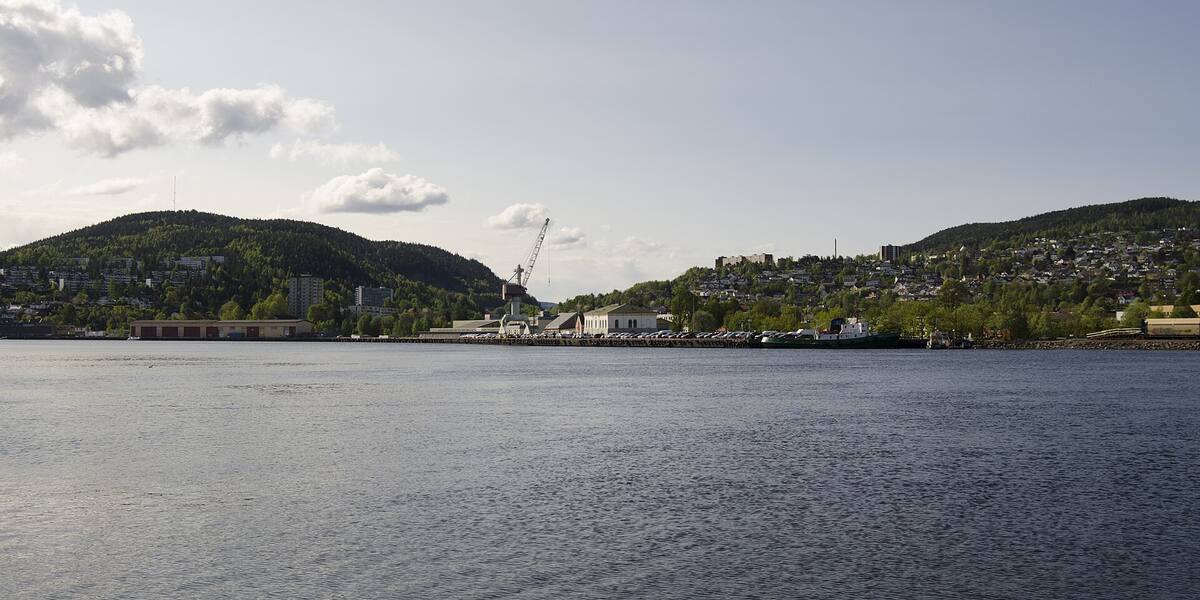
At the head of the Drammensfjord, where the Drammenselva comes out, lies Holmen: flat, industrial, covered in row after row of new cars. Nobody comes ashore here for the day, but the island is worth pointing out. This is the largest car import harbour in Norway, and it carries two big bridges and the railway line across the river mouth. The quayside is a working port, so keep a little way out in the fjord.
Road (rv291) from Brakerøya and Strømsø; the Drammen railway line crosses the island.
The island is connected by road, so you need neither a boat nor a timetable.
Holmen was originally part of the Brakar estate. A windmill stood here around 1670 and gave the island the name Møllerholmen for a period. Industry arrived in earnest at the end of the 1700s: in 1779 Anders Robsahm, Anders Søberg and Gabriel Omsted set up the first Holmen shipyard, which built two ships before it closed in 1786. Caspar von Cappelen bought the island in 1798 as a summer residence, and a ropewalk followed in 1806. In 1838 Holmen passed to the city's captain, Johan Frederik Thorne, for 8,000 speciedaler. He ran a shipyard, a blubber rendering plant and a dye works. After Thorne went bankrupt, Hermann Arnemann built Drammen's first steam sawmill here in 1855. The railway crossed the island on the Holmen bridges from 1872, the longest railway bridges in Norway at the time.
Holmen is the port of Drammen today. More than 70 per cent of the cars imported into Norway arrive here (2021). In the second half of 2020 alone, over 70,000 vehicles came in.
Holmen is a working port with car imports, a customs station and the railway. On the west side is Holmenokken, a park used for midsummer celebrations among other things, with Hilde Aagaard's sculpture *Sit in sight* from 2011.
Holmen is connected to the mainland by national road 291 and two bridges, from Brakerøya and Strømsø. This is not an island you land on from a boat. The waterfront is commercial quay, so keep clear of ships under way. There is no coastal cabin, no public guest dock and no known access restriction.
The 54-metre grain silo opened on 29 October 1971 with room for 12,000 tonnes. A secret room at the top was used by the police security service, PST, to watch the harbour (Soviet car import firms in particular) until 1992. That the room had ever existed only became known in 2012.
The island was once called Møllerholmen, after a windmill from around 1670. The first shipyard, founded in 1779, built two ships and closed after seven years.
Oslo Sea Experience passes Holmen on its private fjord trips from Tjuvholmen.
The Norwegian version notes which facts were taken from each source: Holmen på norsk.