Photo: Tore Sætre·CC BY-SA 4.0· Wikimedia Commons
Islands / Oslo / Heggholmen
Island joined to Gressholmen and Rambergøya by infill. Heggholmen lighthouse on the northern tip is the oldest in the inner Oslofjord and is a protected monument. There was industry here once, a steam-driven linseed oil press and soap production, with remains of the workers' housing and the school building. A few private cabins.
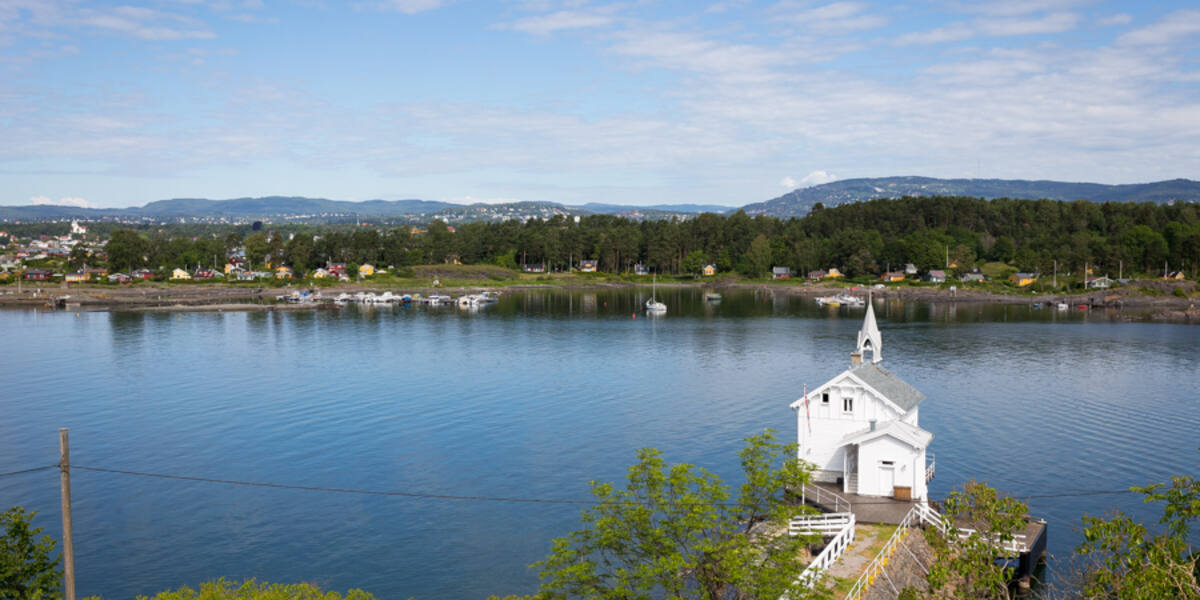
Heggholmen is the westernmost of the three linked islands. Gressholmen, Rambergøya and Heggholmen hang together on stone infill. The small white lighthouse in Swiss chalet style stands straight on the rock at the northern point. It is the oldest lighthouse in the inner Oslofjord.
Nature reserve (protected June 2008); the lighthouse and the industrial remains are protected monuments. The boundaries and the rules are in Naturbase, and they are worth checking before you land anywhere outside the marked areas.
Private boat or kayak, or on foot via Gressholmen (ferry from Rådhusbrygge 4).
Boats do run here, but the quay is not in Entur’s system. It is usually a summer service or a private crossing that never enters the national journey planner. Check with the operator before you build a day around it.
In 1827 Christiania Havnecommision, the harbour commission of the city now called Oslo, made an agreement with the pilot Svend Iversen to keep a light burning on the islet. That was the first light on Heggholmen, and no lighthouse in the inner Oslofjord is older. The present building went up in 1876 in Swiss chalet style, unusual among Norwegian timber lighthouses. The tower is 6.5 metres high, and the light is 15.2 metres above the sea. Heggholmen was the first lighthouse in Norway to get electric light, in 1928. It was automated in 1959 and closed in 1972. The lighthouse is a protected monument.
The island also had industry. A steam-driven linseed oil press and soap production ran here, and there are still remains of the workers' housing and a school building from the industrial period. The conservation organisation Norsk Naturarv restored the site between 2005 and 2008.
Heggholmen is part of the recreation area together with Gressholmen and Rambergøya. There are a few private cabins. The lighthouse and the industrial remains have been preserved. People come for the rocks, the swimming and the walk between the islets on foot.
The simplest route is the ferry to Gressholmen from Rådhusbrygge 4, then on foot across the stone infill to Heggholmen. Private boats and kayaks can land at the rock shelves. The island became a nature reserve in June 2008, and the lighthouse and the industrial remains are protected monuments. Check Naturbase, the national database of protected areas, for the current reserve boundary and for access rules in the nesting season before going ashore away from the prepared spots. Nothing is to be removed from the monuments.
The light here went electric before any other lighthouse in Norway, in 1928, out on an islet in the Oslofjord.
It began in 1827 with a single pilot who kept the light burning under contract. The Swiss chalet building there now came only in 1876.
The island was industry before it was recreation: a steam-driven linseed oil press and soap boiling, with a school of its own for the workers' families. The foundations are still there.
Oslo Sea Experience passes Heggholmen on its private fjord trips from Tjuvholmen.
The Norwegian version notes which facts were taken from each source: Heggholmen på norsk.