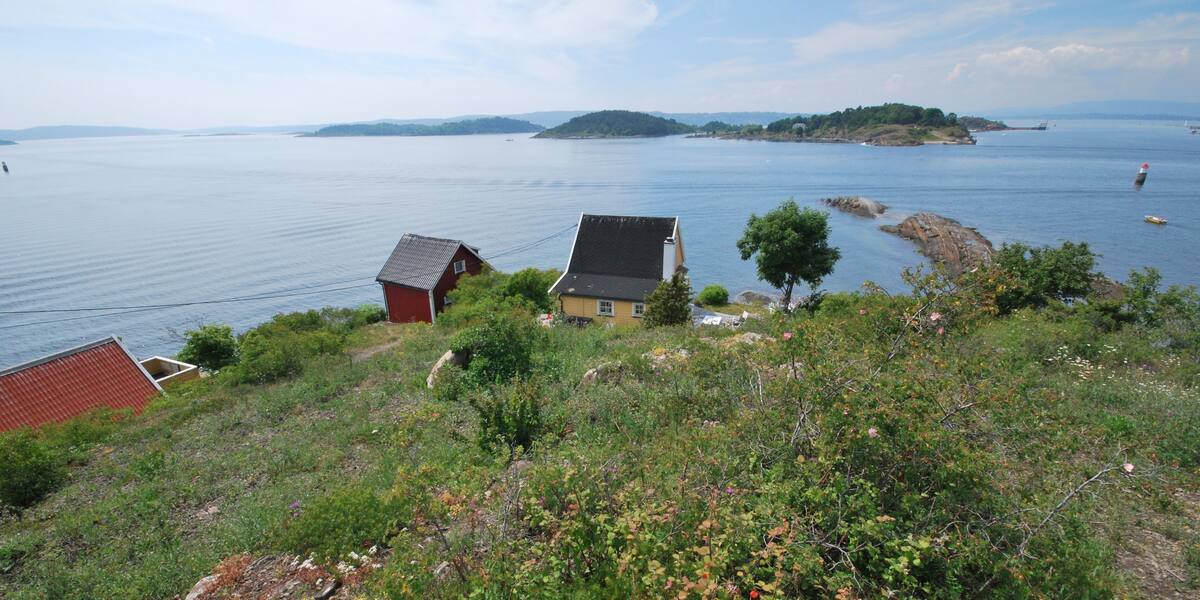
Photo: Helge Høifødt·CC BY-SA 3.0· Wikimedia Commons
Islands / Oslo / Bleikøya
A small island in the inner Oslofjord between Hovedøya and Sjursøya, with around 90 holiday cabins from the 1920s and 30s. From 1885 to 1926 it held a sanatorium for children with scrofula, a form of tuberculosis. The writer Oskar Braaten was a patient here as a boy. State-owned and managed by Statsbygg, the government property agency.
Between Hovedøya and Sjursøya lies a long, low island covered in small brightly painted cabins, about a kilometre from end to end. From the water you see the cabins packed along the west side, and forest and bare rock towards the north. Sick children lived here before the cabin owners came.
Bleikøya nature reserve (7.4 hectares (74 dekar)) on the northeast of the island; landing on the islet Bleikøykalven is banned in the breeding season, 15 April to 15 July. The boundaries and the rules are in Naturbase, and they are worth checking before you land anywhere outside the marked areas.
Year-round ferry from Rådhusbrygge 4, the City Hall quays.
Times shift with the season, and several of the island boats run only in summer. Check the current timetable at Ruter.
Bleikøya covers about 12.5 hectares (125 dekar). From 1885 to 1926 a sanatorium here treated children with scrofula, a form of tuberculosis that attacks the lymph nodes. It began in the 1864 villa of a director named Gjerdrum and grew to house around 35 patients. Among the children treated here was the writer Oskar Braaten, who later wrote about his stay in the story *Overgivelse*.
When the sanatorium closed, the authorities opened the island to cabin building. The Ministry of Agriculture gave permission in 1926, and the roughly 90 small cabins went up through the 1920s and 30s. The rules are still strict: a cabin may be no more than 32 square metres, with a ridge height of 4.8 metres. The island also has Bleikøyplassen, a former crofter's holding (*husmannsplass*) said to have been lived in by the same family since the 1700s.
Bleikøya is state-owned and managed by Statsbygg as public open space. The roughly 90 cabins are holiday homes, and the island has swimming spots and rock shelves open to everyone. The northeastern part is a nature reserve.
A year-round ferry runs from Rådhusbrygge 4 at the City Hall. Your own boat can tie up or anchor in the coves around the island. Bleikøya nature reserve covers 7.4 hectares (74 dekar) on the northeast side. Landing on the islet Bleikøykalven is forbidden in the breeding season, 15 April to 15 July. This is law rather than advice, and it applies every year. Check Naturbase, the national database of protected areas, for the current reserve boundary before going ashore away from the prepared spots.
The sanatorium ran from 1885 to 1926, treating children with glandular tuberculosis in fresh sea air. The cabin owners came afterwards.
The writer Oskar Braaten was a patient here as a child and later wrote about it in *Overgivelse*.
The cabins look small by design. The rules cap them at 32 square metres and a ridge height of 4.8 metres, so the building has stayed low and plain for a hundred years.
Bleikøyplassen, the old crofter's holding, is said to have had the same family living there since the 1700s, well before either the sanatorium or the cabins.
Oslo Sea Experience passes Bleikøya on its private fjord trips from Tjuvholmen.
The Norwegian version notes which facts were taken from each source: Bleikøya på norsk.