Photo: Wilhelm Joys Andersen (Flickr)·CC BY-SA 2.0· Wikimedia Commons
Islands / Oslo / Hovedøya
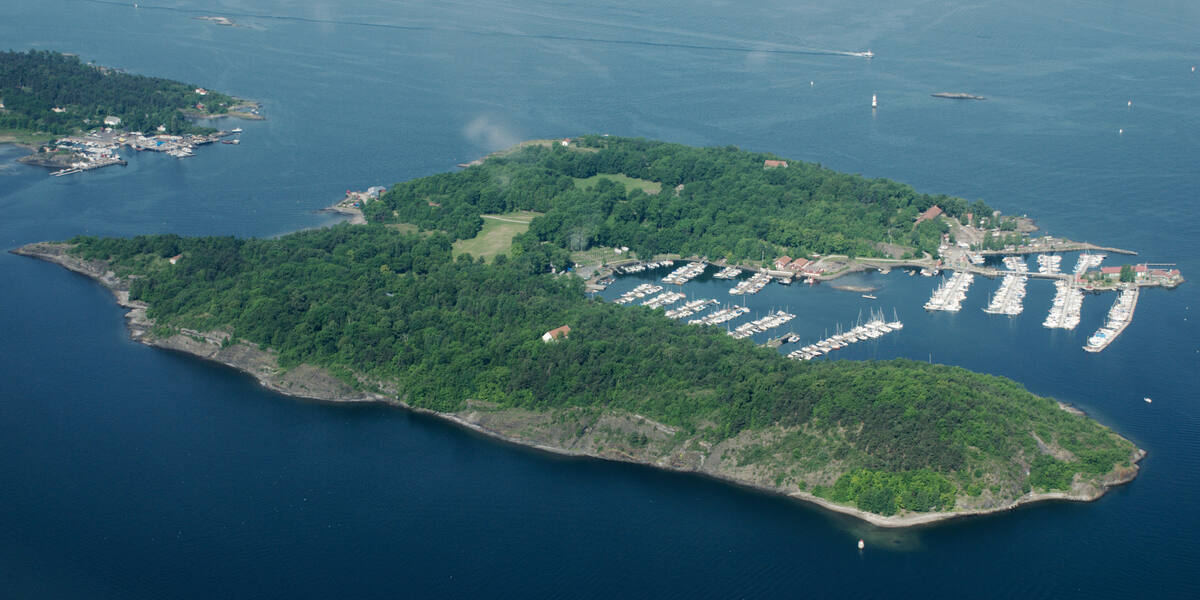
Oslo's best-known recreation island (0.47 km²), full of history: the ruins of a Cistercian monastery founded in 1147, medieval quarries, fortifications from 1808 with their cannon and powder magazines, and German army barracks from the Second World War. Rich plant life, notable geology, and popular places to swim.
Just south of Vippetangen, less than 500 metres off the mainland, lies the island with more history on it than anywhere else in Oslo. From the water you see the monastery ruins on the north side, the gun emplacements down at the shoreline and the yellow military buildings among the broadleaf trees. The ruin shows best from there, with the city behind you. It dates from 1147.
Four protected areas established in 2006 (landscape protection and nature reserves). The boundaries and the rules are in Naturbase, and they are worth checking before you land anywhere outside the marked areas.
Part of Kystled Oslofjorden. See all the coastal trail cabins.
Ferry from Rådhusbrygge 4 (less than 500 m from shore).
Times shift with the season, and several of the island boats run only in summer. Check the current timetable at Ruter.
Hovedøya covers 0.47 square kilometres, 46.9 hectares (469 dekar), and has been in use for close to 900 years. In 1147 English monks founded a Cistercian monastery here, Sanct Edmund and Sancta Mariae, under Abbot Philippus from Kirkstead in Lincolnshire. It grew rich and powerful, ending up with some 443 properties, among them the large estates at Bygdøy and Bogstad, and the abbot carried real political weight.
The Reformation ended it. The last abbot was imprisoned in January 1532, and on 4 and 5 June the same year it burned down in fighting. From the 1540s the ruin was used as a quarry, and stone from it went into Akershus fortress among other places. What survives is still among the most complete medieval monastic complexes in Norway.
The next chapter was military. During the Napoleonic Wars two gun batteries were built here in 1808, Østre and Vestre batteri, to control the approach to the harbour. Five powder magazines followed between 1826 and 1827, far more than the island itself had any use for. Hovedøya was where the city kept its gunpowder at a safe distance. In 1847 came Lavetthuset, the gun-carriage house, said to be the largest half-timbered building with brick infill in Norway.
During the Second World War the Germans built a large barracks camp east of the monastery, Lager Hauptöen. It had eleven barracks and more than a thousand men from the navy and the labour service. After the liberation the German camp was used to intern around 1,100 women held as *tyskertøser*, accused of relationships with German soldiers, until April 1946. About 150 families then lived there until the mid-1950s.
People come to Hovedøya for the monastery ruin, the swimming spots, the walking paths and the preserved military buildings. Plant life is rich, and the geology is well known for its Cambro-Silurian limestone and fossils. Cultural monuments and nature are side by side across the whole island.
The ferry leaves from Rådhusbrygge 4, the City Hall quay, and the crossing is short. Private boats can tie up at the quays and anchor in the bays around it. Since 2006 most of Hovedøya has been divided into four protected areas covering geology, plant life and cultural monuments. The boundaries and the rules are in Naturbase, the national database of protected areas, and should be checked before you go ashore anywhere outside the prepared sites. The ruin and the fortifications are protected cultural monuments. Walking there is allowed, but nothing may be removed or climbed on.
The monastery here once owned half the Oslo area, some 443 properties, including both Bygdøy and Bogstad. When it was pulled down after the Reformation, the stone ended up in Akershus fortress.
The monks who founded the monastery in 1147 were English, from Kirkstead in Lincolnshire. The abbot's name was Philippus.
The five powder magazines from the 1820s were oversized on purpose. The city wanted its gunpowder well away, on an island you could get off if something went wrong.
After the war around 1,100 women were interned in the former German barracks here, accused of relationships with German soldiers. The camp ran until April 1946.
Oslo Sea Experience passes Hovedøya on its private fjord trips from Tjuvholmen.
The Norwegian version notes which facts were taken from each source: Hovedøya på norsk.