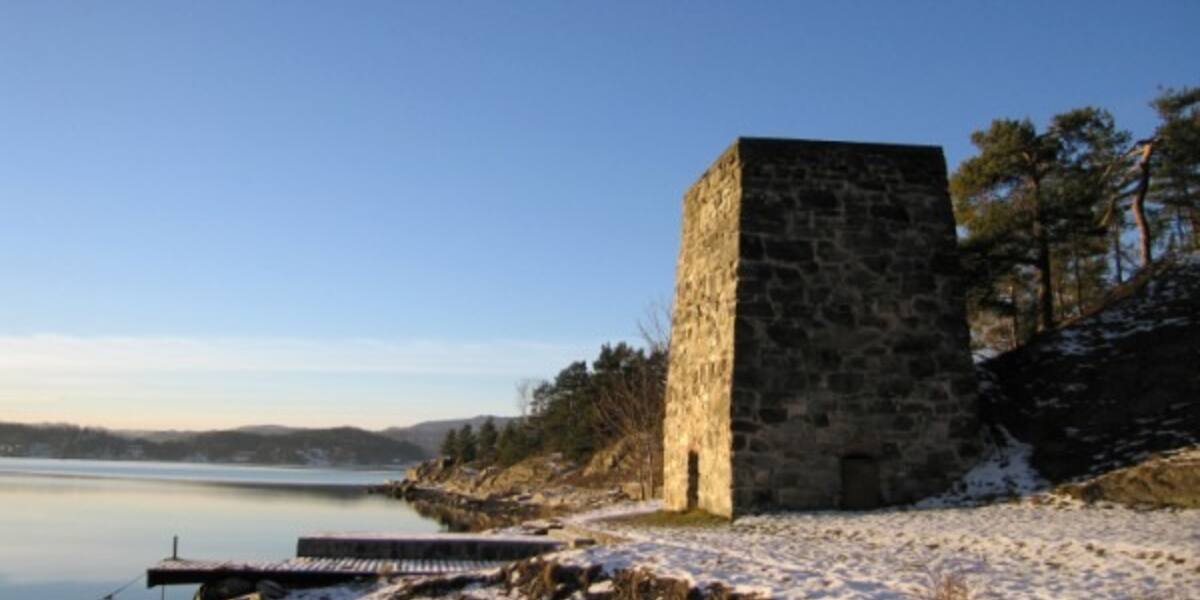
Photo: Tor Stein·Public domain· Wikimedia Commons
Islands / Asker / Brønnøya
An inhabited, effectively car-free island with both year-round homes and a great many cabins. Five old lime kilns are recorded, and the kiln from 1892 is the main sight here. Stone Age settlement sites have been found on the high ground.
On the east side, towards Vendelsund and the narrow sound to Nesøya, a small cable ferry hauls itself across the 38 metres. The island is 2.5 km long and 1 km wide, packed with cabins in the woods and car-free in practice. The masonry lime kiln from 1892 down at Sandbukta is the clearest industrial trace left. The name comes from the wells on the island. *Brønn* is Norwegian for well, and sailors used to take on fresh water here.
Viernbukta nature reserve and Vendelholmene nature reserve. The boundaries and the rules are in Naturbase, and they are worth checking before you land anywhere outside the marked areas.
cable ferry from Nesøya in summer (floating bridge in winter); boat service to Sandvika.
The island is connected by road, so you need neither a boat nor a timetable.
People have been on Brønnøya a long time, with settlement sites from the Stone Age found on the high ground. The farm Brønnøya (land-register no. 41) is documented from the early 1800s. In 1826 it had around 21.6 hectares (216 dekar) of cultivated land, four horses, sixteen cows and twenty sheep.
The bedrock is Cambro-Silurian, shale and limestone tilted almost on end by movements in the earth's crust. The lime is what made the industry possible. Lime has been burned here since the Middle Ages, and five old kiln ruins are recorded on the island. The big push came in 1892, when the industrialist Caspar Donato Brambani bought the islands and started large-scale lime burning for export. The masonry kiln at Sandbukta was built the same year, but the operation closed as early as 1900 because it did not pay.
The ships that came for the lime arrived in ballast and dumped it on the shore before loading. The ballast was soil from foreign ports, and non-native plants came with it and took root. That is why the flora on Brønnøya is unusually rich in species.
Prinsehytta, the prince's cabin, got its name after consul Nielsen lent it to Oscar II's grandsons Gustav Adolf and Wilhelm on several occasions.
Of 362 private plots, 16 are approved year-round homes and 261 are cabins. People come for cabin life, swimming and walks on the old lime tracks. A heritage trail takes you past the kilns and the Stone Age sites. A small population of roe deer lives here.
A small cable ferry connects the island to Nesøya in summer. The current ferry entered service on 1 May 2004 and crosses the 38 metres of Vendelsund. In winter it is replaced by a floating bridge, which may be used from 15 September to 1 May. In summer there is also a boat service to Sandvika. Private boats can tie up at the quays. Most of the shoreline is private.
**Protection:** Viernbukta nature reserve (shallow-water wetland with sea and wading birds) on the east side, and Vendelholmene nature reserve (specialised shore-meadow vegetation) on the north side. Respect the marked access bans in the reserves. The rest of the island is largely private.
The non-native flora arrived literally as ships' ballast: soil from foreign ports, dumped on the shore more than a hundred years ago.
The cable ferry capsized on Midsummer Eve in June 1982 with around 40 passengers aboard, after a man jumped on once it had left. It ended in court cases and compensation settlements.
The winter bridge has been rebuilt in one material after another: railway sleepers (1961), oil drums (1964), polystyrene blocks (1980) and finally concrete and timber (2003).
The rock under the island is turned almost 90 degrees. Cambro-Silurian sea floor stands on end, which is why the lime lay within reach of the kilns.
Oslo Sea Experience passes Brønnøya on its private fjord trips from Tjuvholmen.
The Norwegian version notes which facts were taken from each source: Brønnøya på norsk.