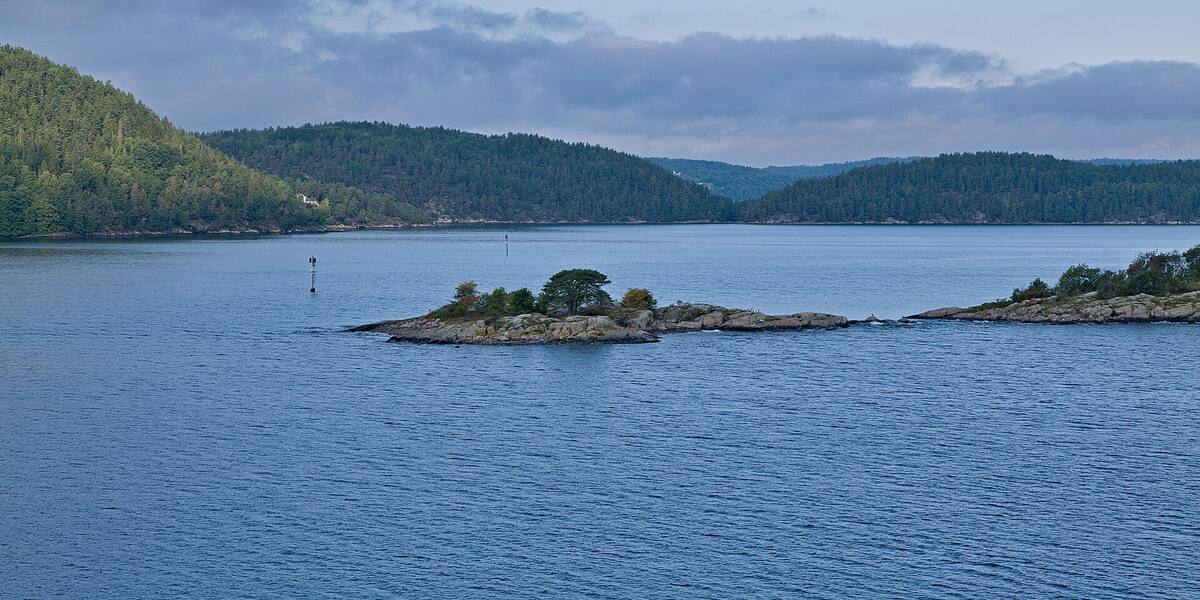
Photo: Leonhard Lenz·CC0· Wikimedia Commons
Islands / Frogn / Askholmene
Four small skerries about 4.7 km north of Drøbak. The easternmost is a nature reserve for its bird life. The others are public recreation ground. Several hundred survivors from the Blücher came ashore here on 9 April 1940.
Four low skerries, around 4.7 km north of Drøbak church. There is nothing dramatic to look at, and the highest point is 12.5 metres. But this is where the survivors from the Blücher swam ashore on 9 April 1940, and the cruiser went down close by.
the easternmost skerry is a nature reserve (bird life); check Naturbase for access restrictions. The boundaries and the rules are in Naturbase, and they are worth checking before you land anywhere outside the marked areas.
own boat or kayak; public recreation area (except the reserve skerry).
No scheduled boat comes here. You will have to find the nearest public quay yourself, and the rest is your own boat or a kayak. Check the wind and wave forecast before you set out. The open stretches in the outer fjord turn unpleasant in a fresh breeze.
Askholmene is four small skerries totalling around 2 hectares (20 dekar). The easternmost is protected as Nordøstre Askeskjær nature reserve for its bird life. The others are zoned as open recreation ground.
Askholmene is tied to the best-known naval action in Norwegian history. The German cruiser Blücher was hit by the guns and torpedoes from Oscarsborg. The burning ship drifted north and sank west of Askholmene at around 06.23 on 9 April 1940. Somewhere between 650 and 1,000 of the crew died, and around 1,400 survived. A couple of hundred scrambled up onto the rock. To keep warm on the cold April morning they stood close together and jumped in a ring until help arrived.
On 24 July 1940 the Germans raised a memorial to their dead here. It was pulled down at the liberation in May 1945. The foundation is still there.
The three that are not a reserve are used for outdoor recreation. They are low smooth rock, easy to land on from a boat or kayak, with no facilities to speak of.
Access is by private boat or kayak. The three western skerries are open recreation ground and free to walk on. The easternmost, Nordøstre Askeskjær nature reserve, is closed during the nesting season for the sake of the birds. Check Naturbase, the national database of protected areas, for the exact dates and boundary before going ashore. Do not guess at the protection dates.
A couple of hundred German sailors got through the night by jumping in a ring on a skerry to keep warm.
The Blücher still lies on the bottom in the sound south of the skerries, and still leaks oil, which is pumped out at intervals.
The memorial the Germans raised in July 1940 stood for less than five years. Only the foundation is left.
Oslo Sea Experience passes Askholmene on its private fjord trips from Tjuvholmen.
The Norwegian version notes which facts were taken from each source: Askholmene på norsk.