Photo: Tommy Gildseth·CC BY-SA 4.0· Wikimedia Commons
Islands / Fredrikstad / Torgauten
A headland at Øyenkilen in the old Onsøy district. Torgauten fort was a German coastal battery (HKB 6/980), built in 1941 to defend the approach to the Glomma. The Norwegian armed forces used it until about 1993. It is now a museum with guided tours on some summer Sundays. A popular place to walk, with coves for swimming.
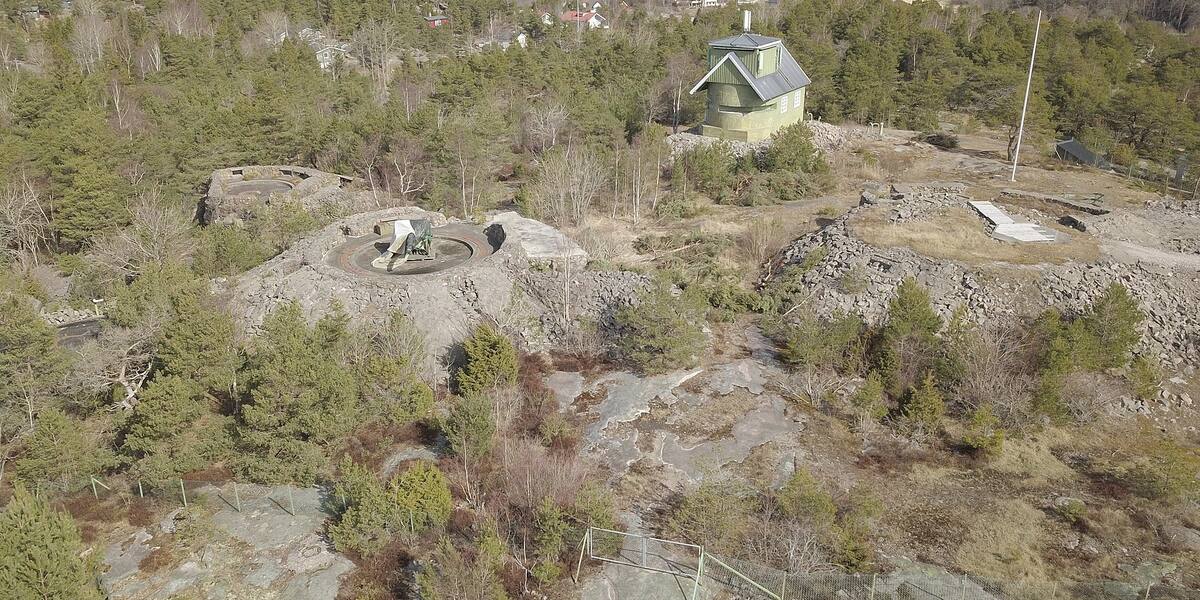
Torgauten is on the west side of the approach to the Glomma, at Øyenkilen in the old Onsøy district. From the low, wooded headland you look inland towards Vesterelva and Fredrikstad. What you are looking at is an old coastal fort. A German gun still stands up on the rock, and hidden in the terrain are casemates, communication trenches and a command building painted to look like an ordinary house.
road access; open to the public.
The island is connected by road, so you need neither a boat nor a timetable.
Torgauten was laid out by the Germans in April and May 1941 as a coastal battery under Artilleriegruppe Fredrikstad. Its military designation was Heeres Küsten Batterie HKB 6/980 Torgauten. The battery was given four 10 cm K17/04 guns with a range of 14,000 metres, covering the western approach to the Glomma. Kjøkøy fort on the eastern side covered the other channel. Construction continued right up to the end of the war.
Norwegian construction workers built the installation, and drawings and specifications were smuggled out to England during the occupation.
The Norwegian armed forces took over after 1945. From 1948 the site was used as a training area for sixteen years. An early-warning radar was installed in 1953, and the fort was modernised through the 1970s and 80s with two 10.5 cm guns in casemates. Torgauten worked as a coastal artillery fort until the early 1990s and was closed down around 1993. Mørvika fort on the Ringdalsfjord came under Torgauten's command.
Torgauten is a listed site and a museum, with guided tours on some Sundays in summer. Most of the original buildings have been demolished, but trenches and bunkers remain in the terrain, and one K17/04 gun is preserved on site. The area is a popular place to walk, with coves for swimming and a road out to it.
Torgauten is reached by car and is open to the public. From the sea there is good anchorage in the coves around the headland. Museum tours are run by the fort's association of friends on selected Sundays in summer. Check the announced dates before planning around a tour. No protection order is known to close the headland itself. The fort is a listed cultural monument, and the site stays open.
The command building was camouflaged as a civilian house, with a pitched roof and painted-on false windows, so that a passing aircraft would see a farm rather than a fort. The Norwegian work crew that built the installation for the Germans made sure British authorities got detailed drawings of what they were putting up. And the four German guns were never fired in anger. They stood here on alert through the whole war, against a seaborne invasion that never came this way.
Oslo Sea Experience passes Torgauten on its private fjord trips from Tjuvholmen.
The Norwegian version notes which facts were taken from each source: Torgauten på norsk.