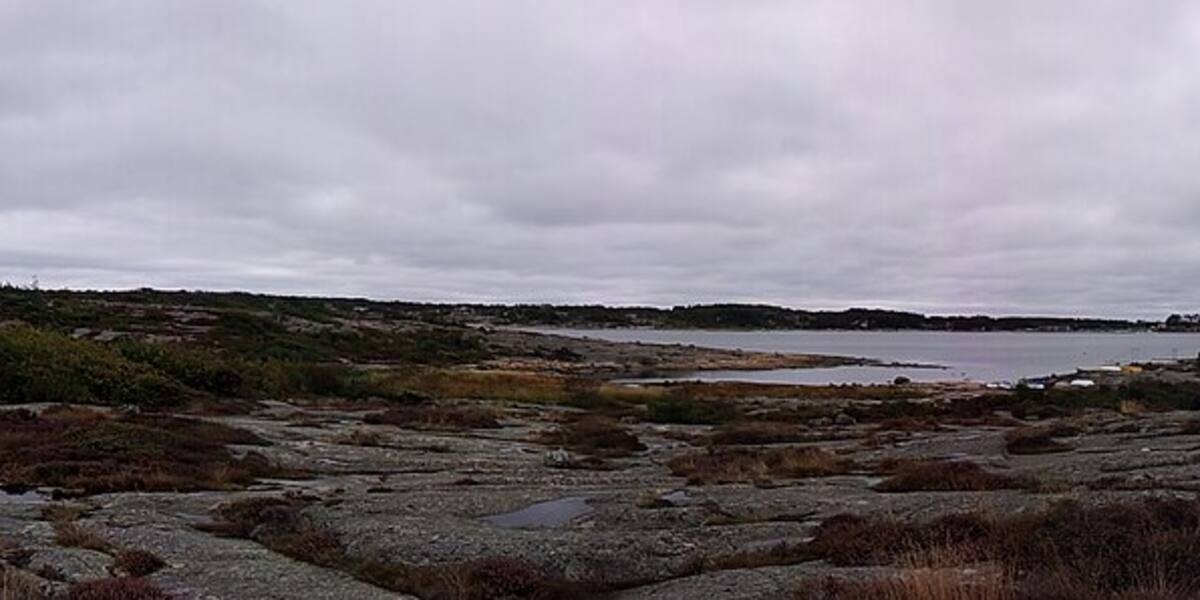
Photo: Premeditated·CC BY-SA 4.0· Wikimedia Commons
Islands / Hvaler / Spjærøy
A long, wooded main island with road access and bridges to Vesterøy and Asmaløy, and on to the mainland through the Hvaler Tunnel. It has Spjærøy church and the housing estate Sydengen.
Spjærøy fills the middle of Hvaler, wedged between Vesterøy to the west and Asmaløy to the east, with bridges to both. From the water you see a low green ridge with scattered buildings. The landmarks are Spjærøy church in granite and the Sydengen housing estate on the north side.
Part of Kystled Oslofjorden. See all the coastal trail cabins.
road access (bridges and the Hvaler Tunnel).
The island is connected by road, so you need neither a boat nor a timetable.
Spjærøy is 8 km² and has been one of the Hvaler main islands with permanent settlement. Its clearest monument is the church. The Hvaler district resolved on 26 May 1887 to build a new chapel with 175 seats. The foundation stone with its silver plate was laid on 22 May 1889, and the building was finished and consecrated on 24 July 1891 by Bishop Carl Peter Parelius Essendrop.
The architect was Jacob Wilhelm Nordan. The church is built in granite quarried from the rock just south of the site. The master mason was Peder Emanuelsen Utengen from Kirkøy: stone taken on the spot, laid by a local man. It was originally Spjærøy chapel and has 150 seats. It was renovated in 1941, 1958 and 1989, and is called a church today.
When the Hvaler Tunnel opened, Spjærøy and the western Hvaler islands got a fixed road connection to the mainland by bridge and tunnel. That was the end of Spjærøy's time as a ferry community.
Sydengen on the north side is the only real housing estate on the island. Otherwise Spjærøy is a mix of year-round homes, cabins and forest, with roads and bridges to the neighbouring islands and on through the Hvaler Tunnel to the mainland. The church is still in use and belongs to the Fredrikstad cathedral deanery.
Spjærøy is reached by car the whole way: bridges from Vesterøy and Asmaløy, and the Hvaler Tunnel under the Løperen sound from the mainland. No ferry is needed. Private boats can put in on the south side. There are no known access bans or protected areas on the island itself.
The granite came out of the rock right beside the site. The church was literally raised from the ground it stands on.
The master mason, Peder Emanuelsen Utengen, came from neighbouring Kirkøy. Both the stone and the man who laid it were local to Hvaler.
Spjærøy church has its address on Dypedalsveien, on the boundary towards Vesterøy. The name of an island and the name of a road do not always follow the same line in people's heads.
Oslo Sea Experience passes Spjærøy on its private fjord trips from Tjuvholmen.
The Norwegian version notes which facts were taken from each source: Spjærøy på norsk.