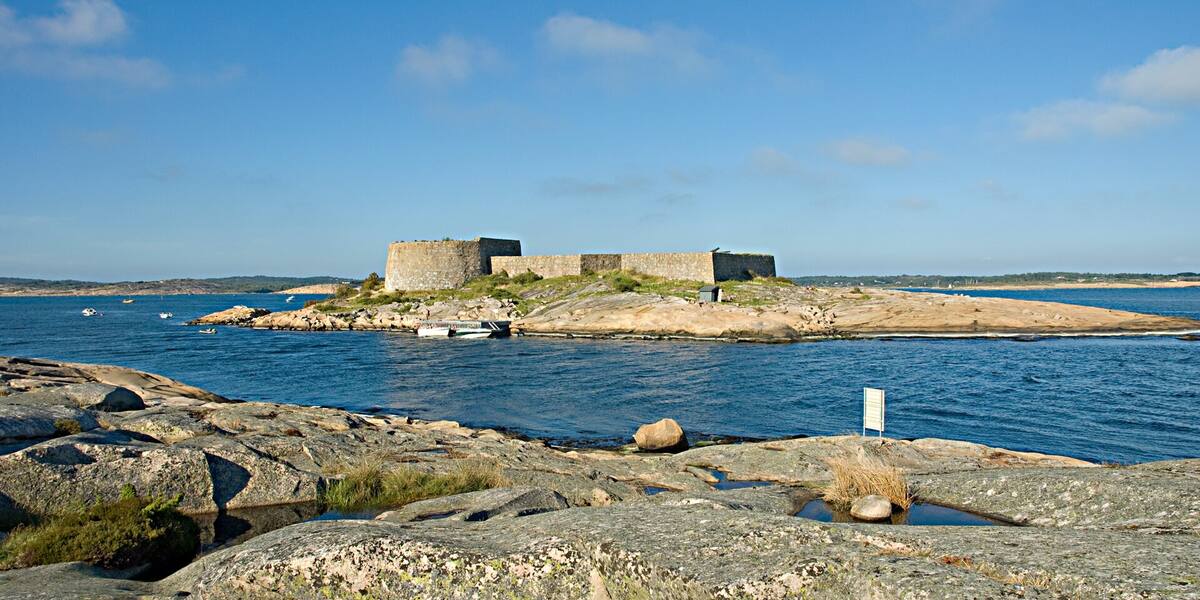
Photo: Kyrre·CC BY-SA 3.0· Wikimedia Commons
Islands / Hvaler / Akerøy
Uninhabited island at the outer edge of Hvaler, with Bronze Age burial cairns and an old redoubt on the highest point. It is a well-known stopover for migrating birds, with its own ornithological station since 1961. The writer Johan Borgen's old house is a popular coastal trail cabin (*kystledhytte*). Part of Ytre Hvaler National Park.
Out at the edge of the Hvaler archipelago, southwest of Kirkøy, there is a low grass-covered island with a stone wall on top. That is the redoubt on the island’s highest point. Akerøy fort itself stands on Festningsholmen, the small islet northeast of it. From the south side you see the wall, and how narrow the approach to Fredrikstad is. That explains why someone fortified this spot.
Nature reserve (since 1978, access banned in the breeding season) and part of Ytre Hvaler National Park. The boundaries and the rules are in Naturbase, and they are worth checking before you land anywhere outside the marked areas.
Private boat or kayak; the coastal trail cabin can be rented.
No scheduled boat comes here. You will have to find the nearest public quay yourself, and the rest is your own boat or a kayak. Check the wind and wave forecast before you set out. The open stretches in the outer fjord turn unpleasant in a fresh breeze.
The island was called Saltholmen in the saga period, after the shallow rock pools where people boiled seawater down to salt. Bronze Age people buried their dead here, and several cairns remain near the highest point, 33 metres above sea level.
The fortress history begins in 1664. General Rüsenstein put up a small timber redoubt on Festningsholmen to close the approach to Fredrikstad against Swedish warships and privateers in the Skagerrak. Around 1680 General Johan Caspar de Cicignon rebuilt it in stone. He was the same engineer who laid out the street grid of Kristiansand and built Fredrikstad fortress. At its strongest it held 27 guns and up to 150 soldiers in wartime. In peacetime, in 1801, only 19 men were stationed there.
The end came with the Napoleonic Wars. After Denmark-Norway lost its fleet in 1807, the fort had no ships to fall back on and no secure supply lines. Prince Christian August ordered it demolished in 1808, and it lay in ruins for more than a century and a half. A restoration committee took up the work in 1962, and through the 1960s most of the masonry was rebuilt with state funding and volunteer labour. Work stopped in 1999 when the money ran out.
Akerøya was grazed for a long time. Cattle kept the vegetation down here until around 1950. The writer Johan Borgen had a house on the island.
Ownership is shared between the state and Oslofjordens Friluftsråd, the regional outdoor recreation council. Akerøya is one of the most used destinations at the outer edge of Hvaler. Borgen's old house takes guests through the summer. The middle of the island is laid out as a public recreation area with room for tents, and there are two sand volleyball courts with tournament nets. The "Øya Open" is held here every summer. Akerøya Ornitologiske Stasjon has monitored bird migration since 1961, and this is a well-known resting place for migrating birds. More than 400 plant species have been recorded, several of them threatened.
Access is by private boat or kayak. The cabin is booked through Oslofjordens Friluftsråd. The east and west sides are a nature reserve, established in 1978 for seabirds, with access banned during the breeding season. Check the current dates and the signs before you tie up there. The ban follows from the protection regulations and is not a recommendation. All of Akerøya is inside Ytre Hvaler National Park, established on 26 June 2009 as Norway's first marine national park, together with Kosterhavet on the Swedish side. The recreation area in the middle is open to the public and to camping.
Cicignon, the man behind the stone fort here, is the same engineer who drew up Kristiansand and built Fredrikstad.
The fort was never beaten in battle. It was pulled down on our own prince's order, because there was no longer a fleet to defend it with. The Napoleonic Wars finished the place off without a single Swedish gun being fired at it.
When the national park was established in 2009 it replaced four older seabird reserves: Akerøya, Heia, Møren and Søndre Søster. Below the surface lies Tislerrevet, the largest known inshore cold-water coral reef in the world.
Oslo Sea Experience passes Akerøy on its private fjord trips from Tjuvholmen.
The Norwegian version notes which facts were taken from each source: Akerøy på norsk.