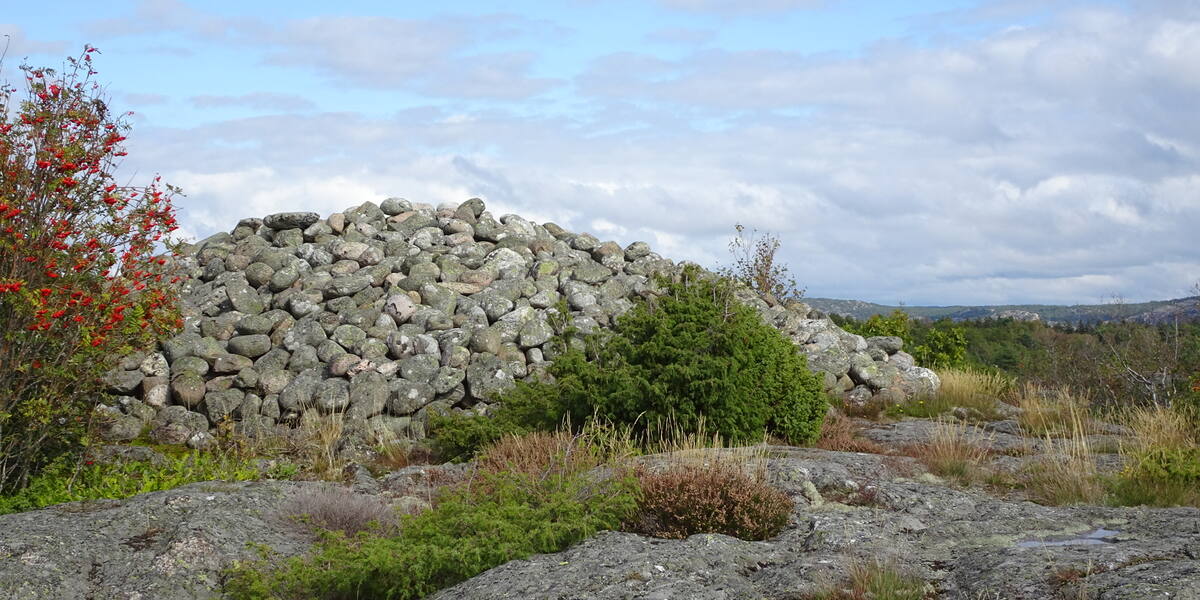
Photo: Stig Ulfsby·CC BY-SA 4.0· Wikimedia Commons
Islands / Hvaler / Søndre Sandøy
Søndre Sandøy is a car-free island in the southeast of Hvaler, with sandy beaches, walking paths and dense conifer forest. Its distinctive gneiss was used as facing stone on Oslo City Hall. Prince Christian Frederik came ashore here in 1813, before he became king. There is a Bronze Age burial cairn at Sanderød and an old herring salting house at Gravningsund.
Søndre Sandøy lies in the southeast of Hvaler, a long wooded island 3.7 kilometres end to end, with sandy beaches along the edges and conifer forest through the middle. From the water you can see the two villages where the passenger boat calls, Nedgården and Gravningsund. The gneiss is exposed along the shore. The same stone faces Oslo City Hall.
| Loading departures … |
Live times from Entur. Full timetable at Ruter.
Passenger boat from Skjærhalden to Nedgården and Gravningsund all year; motor vehicles require a permit.
Times shift with the season, and several of the island boats run only in summer. Check the current timetable at Ruter.
Bronze Age people buried their dead here more than three thousand years ago. The cairn at Sanderød is still there. Fishing sheds stood here in the Middle Ages, and a herring salting house at Gravningsund in the 1800s.
On 21 May 1813 Prince Christian Frederik came ashore on Søndre Sandøy. He arrived in Norway as viceroy (*stattholder*). The following year he was elected king at Eidsvoll, before the union with Sweden forced him off the throne that autumn. The landing on this island was his first step on Norwegian soil in that role.
The gneiss from Søndre Sandøy was quarried as building stone and used as facing on Oslo City Hall. The dark reddish stone in those walls comes from out here in the Hvaler skerries.
Søndre Sandøy was a working farming and fishing community. In 1900, 325 people lived here. Over the following century the permanent population drained away, down to 87 in 2009, and more than 500 holiday cabins took over. It is a summer island today, and was a year-round village before.
Søndre Sandøy is car-free and has around 90 permanent residents, many times that in summer. More than 500 holiday cabins are spread across it. Nedgården and Gravningsund are the two villages and the two ferry landings. Sandy beaches, walking paths, large stands of spruce and pine and a certain amount of farming still shape the island.
A passenger boat runs from Skjærhalden to Nedgården and Gravningsund all year, on a summer and a winter timetable. Outside the summer season, trips to and from both landings must be booked with the operator, at the latest an hour before the departure from Skjærhalden. The island is car-free, and motor vehicles require a permit. Come ashore at the ferry landings. There is a guest harbour for private boats. Respect the signage around the burial cairn at Sanderød, a protected heritage site, and in the seabird areas in the surrounding skerries. Protection regulations there may close them to all traffic during the nesting season.
Look at the walls of Oslo City Hall next time you are there. That stone comes from here. The gneiss from Søndre Sandøy was quarried and shipped up the fjord to face Norway's best-known municipal building.
Christian Frederik set foot on Norwegian soil here on 21 May 1813, on his way to becoming the country's king. A small Hvaler island was the first stop for the man who had the constitution passed at Eidsvoll the following year.
The island held 325 people in 1900 and fewer than 90 a century later. The school, the salting house and the farm are gone. What remains is five hundred cabins and a couple of villages that live three months a year.
Oslo Sea Experience passes Søndre Sandøy on its private fjord trips from Tjuvholmen.
The Norwegian version notes which facts were taken from each source: Søndre Sandøy på norsk.