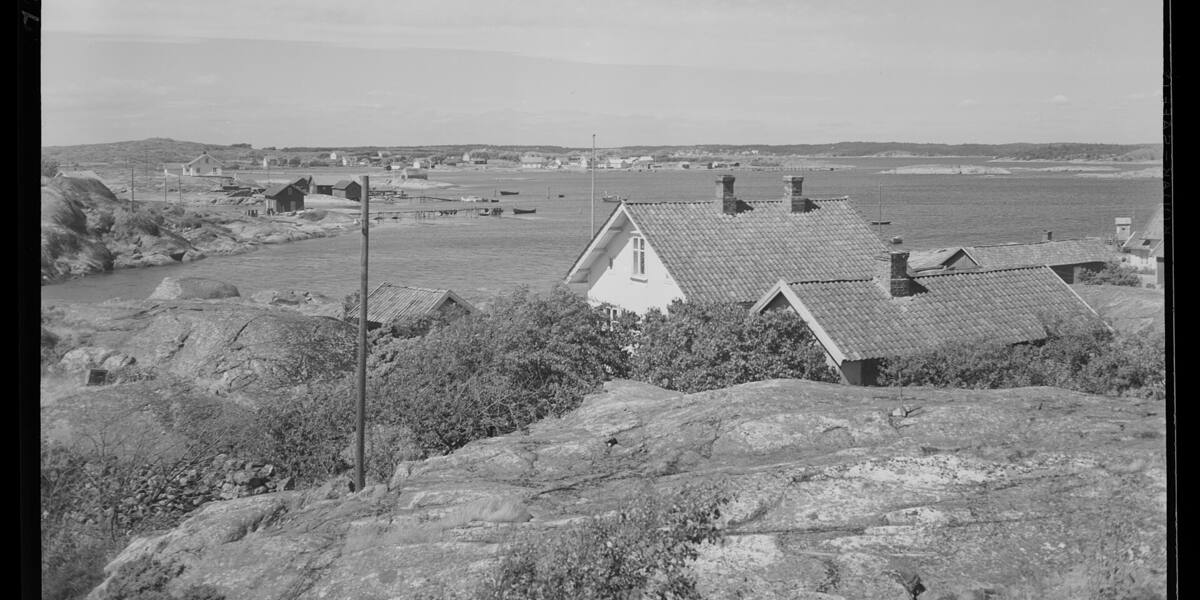
Photo: Unknown authorUnknown author·Public domain· Wikimedia Commons
Islands / Hvaler / Herføl
The southernmost inhabited island on Hvaler, close to the Swedish border, with around 20 permanent residents. Once a fishing station with a customs post and a pilot station, it is now a summer destination with a marina, pub, shop and swimming spot. Protected Bronze Age burial cairns, among them Langrøsset, and the glacial pothole known as Katedralen.
Herføl is the southernmost inhabited island on Hvaler, right down by the Swedish border. From the sea you recognise it by the marina with its pub and restaurant and the white houses around the harbour. Langrøsset, a long Bronze Age cairn, lies at the north end and can be picked out against the horizon. This was a working fishing port with customs officers and pilots until about sixty years ago.
| Loading departures … |
Live times from Entur. Full timetable at Ruter.
Passenger boat from Skjærhalden (nine departures daily).
Times shift with the season, and several of the island boats run only in summer. Check the current timetable at Ruter.
Bronze Age people buried their dead here. Two protected cairns lie on the island: Langrøsset, reckoned the longest in the country, and Herfølsåta. People have used this place for more than three thousand years.
Until the 1960s Herføl was an important fishing station. It had a customs post, a pilot station, a school and a post office, and the catch was delivered to the fish receiving station on Lauer nearby. When the fishing ebbed away, the island became a summer place.
The polar traveller Henry A. Larsen was born here in 1899. He emigrated and became a Canadian policeman in the Royal Canadian Mounted Police. He took the vessel St. Roch through the Northwest Passage, the first to sail it from west to east and the first to cross it in both directions. The road running south from the marina to Andholmen, 1.6 km, carries his name. The writer Jan Kjærstad also has roots on Herføl.
About 20 people live here year round (2021). In summer it fills with boat visitors and cabin owners. The marina, with its pub, restaurant, shop and swimming spot, is the gathering point. The island is 1.96 km².
A passenger boat runs from Skjærhalden with nine departures a day. Check the operator's current timetable, since the times shift with the season. Landing is at the marina, which also has guest moorings. Henry A. Larsens vei links the marina to Andholmen, 1.6 km to the south. No specific access ban is registered on the island itself. Respect the signs around the burial cairns, which are protected monuments, and in the seabird areas among the surrounding skerries.
The man who took the first ship both ways through the Northwest Passage was born on this small island in the outer Oslofjord. Henry A. Larsen went to Canada, became a Mountie, and made St. Roch a name in polar history. The main road on Herføl is named after him.
Langrøsset is reckoned the longest burial cairn in Norway. Bronze Age people laid their dead high and visible facing the sea, a seamark for the living as much as a grave.
The glacial pothole called Katedralen, the cathedral, also known as Hvalgapet, was ground out by the ice. Meltwater under the glacier spun stones around until they had drilled a round chamber into the rock.
Oslo Sea Experience passes Herføl on its private fjord trips from Tjuvholmen.
The Norwegian version notes which facts were taken from each source: Herføl på norsk.