Photo: trolvag·CC BY-SA 3.0· Wikimedia Commons
Islands / Horten / Løvøya
Now a land-connected peninsula near Horten, with a medieval chapel from the 1200s and St. Olav's spring, one of the most important pilgrimage sites in eastern Norway in Catholic times. Boat harbour, campsite and swimming spot.
The peninsula north of Horten has the wooded Veggfjell knoll in the middle. The small stone building down by the water is Løvøy chapel from the 1200s, a pilgrimage destination in Catholic times. Løvøypollen has the boat harbour and the campsite on the inside.
Part of Veggfjell protected. The boundaries and the rules are in Naturbase, and they are worth checking before you land anywhere outside the marked areas.
Road access (land-connected).
The island is connected by road, so you need neither a boat nor a timetable.
Løvøya was originally three islands, Vestre, Midtre and Østre Løvøy, named after the leaf fodder (*løv*) people gathered for winter feed. Vestre Løvøy became land-connected when the road was raised in 1990, with three pipes laid underneath to keep the water in Løvøypollen circulating.
The stone chapel was built between 1223 and 1398, dedicated to St. Hallvard and St. Martin, in a style known from Orkney and Man. Beside it stood St. Olav's spring, whose water was held to have healing power. Pilgrims on their way to Nidaros stopped here, and the place became one of eastern Norway's most important pilgrimage destinations before the Reformation. After 1536 the building fell into ruin for centuries. The ruin was protected in 1882, restored between 1928 and 1950, and reopened for services in 1950. The interior gained a mosaic altar and font by Britt Bakken and Hans Gerhard Sørensen, and an organ in 1969.
Vadfiskerstua, the grill kiosk from the 1930s, still stands and is now part of the campsite.
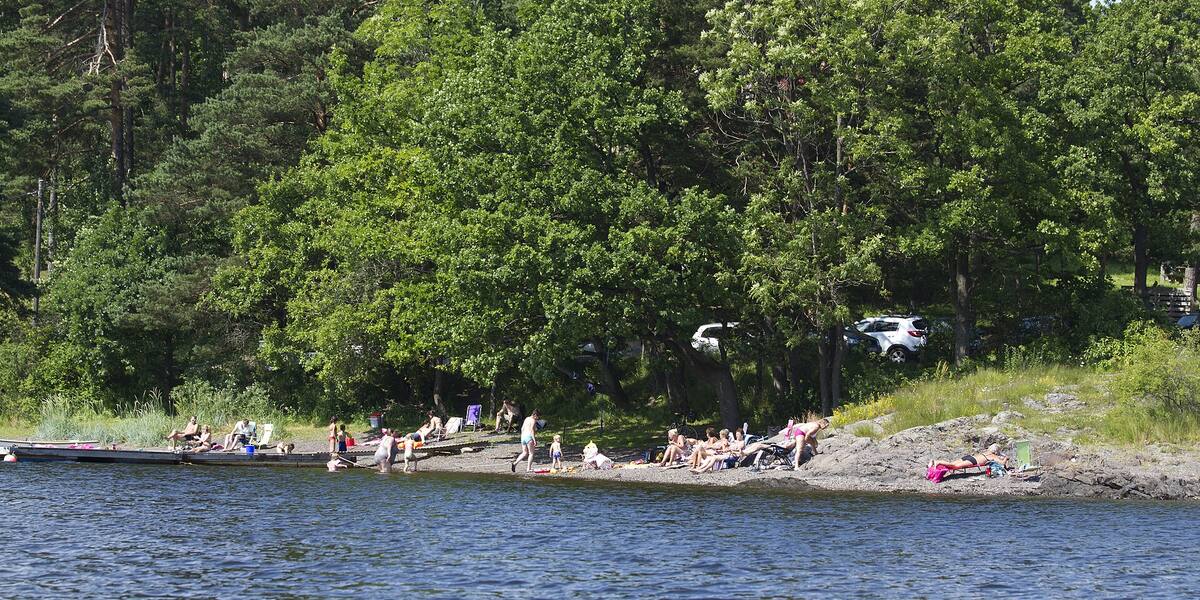
The peninsula has Løvøya Båthavn, Løvøy Camping and a swimming spot. The chapel is used for services and weddings, and St. Olav's Day (*olsok*) is marked here. Veggfjell in the middle has two named formations: Løvehue, the lion's head, on top, and Prekestolen, the pulpit, facing northeast.
Løvøya is land-connected with road access from Horten via Drasundodden, so no boat is needed to get there. From the sea there is a boat harbour with guest berths in Løvøypollen. Protection: the northern part of Veggfjell and the area towards Østre Veggbukt is a protected area. No access restriction is known in the water around, but respect the protected area on land.
The legend of Røverhula on Veggfjell tells of twelve robbers who lived in the cave.
Bays around the chapel carry names from the pilgrimage days: Jesusbukta and Kirkebukta.
The chapel lay in ruin for nearly 350 years after the Reformation before it was raised again in the 1900s.
Oslo Sea Experience passes Løvøya on its private fjord trips from Tjuvholmen.
The Norwegian version notes which facts were taken from each source: Løvøya på norsk.