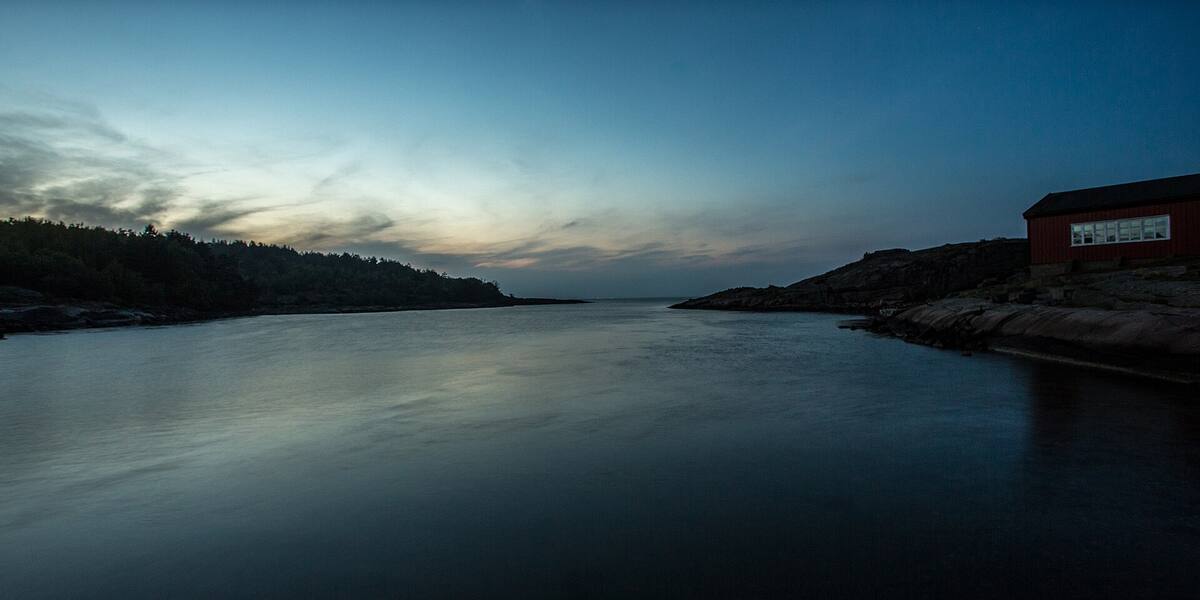
Photo: Kurth Brekke·CC BY 3.0· Wikimedia Commons
Islands / Færder / Bolærne
An island group in the outer Oslofjord off Nøtterøy: the three main islands Vestre, Mellom and Østre Bolæren plus some 40 smaller islets and skerries, 2.6 km² in all. Settled since the 1600s, bought by the Norwegian Armed Forces in 1916 for the Bolærne coastal fort, and now a popular summer destination, with a seasonal ferry from Tønsberg. Most of it falls within Færder National Park.
Three large islands make up the group off Nøtterøy at the mouth of the Oslofjord: Vestre, Mellom and Østre Bolæren, with about 40 islets and skerries around them, 2.6 km² in all. Coming from Tønsberg you meet Mellom-Bolæren in the middle, where the ferry quay is. Wooded Vestre is furthest west, and Østre furthest east with its guest harbour and the old military installations.
Færder National Park. The boundaries and the rules are in Naturbase, and they are worth checking before you land anywhere outside the marked areas.
Seasonal ferry from Tønsberg (Mellom-Bolæren), or your own boat.
Boats do run here, but the quay is not in Entur’s system. It is usually a summer service or a private crossing that never enters the national journey planner. Check with the operator before you build a day around it.
Written sources place settlement on Bolærne back to the 1600s. In the mid-1800s, 33 people lived year-round on Mellom-Bolæren. On the same island is Grevestuen, reckoned one of the oldest hunting lodges in Norway. The name points to the counts (*greve*) who used the group for hunting.
In 1916 the Norwegian Armed Forces bought all of Bolærne to build a coastal fort at the outer approach. Bolærne fort stood on Østre Bolæren and was operational from 1916 to 1999. It formed part of the Outer Oslofjord fortress and was meant to close the fjord together with Rauøy fort on the eastern side. Together the artillery and the minefields sealed the approach to the Karljohansvern naval base and to Oslo.
During the Second World War the installation became part of Festung Norwegen and was heavily expanded by the Wehrmacht. Soviet prisoners of war did much of the work and were held in the prison camp on Mellom-Bolæren. In the autumn of 1944, Soviet prisoners who were dying of illness were gathered there.
Vestfold county bought Østre Bolæren in 2004 and converted the military buildings into an activity and conference venue. The Armed Forces let go of the last installation, on Vestre Bolæren, in 2006.
Bolærne is a swimming and day-trip destination with a seasonal ferry from Tønsberg. Østre Bolæren runs accommodation, a restaurant and a guest harbour in the old fort buildings. Mellom-Bolæren is the best equipped for day visits, with bathing and walking paths. Vestre Bolæren has a quay, a marked coastal trail (*kystled*) around it and a swimming spot at Kalveenga. Most of the group is inside Færder National Park.
A seasonal ferry runs from Tønsberg to Mellom-Bolæren and Østre Bolæren. Times vary with the season, so check with the operator before setting out. Otherwise you come by your own boat or kayak. There is a guest harbour on Østre and quays on Mellom and Vestre. Accommodation and catering on Østre are booked through the operating company. Protection: the group is part of Færder National Park, established 23 August 2013. The seabird reserves are closed to all access from 15 April to 15 July. The coastal spruce forest on Østre is protected. Check Naturbase, the national database of protected areas, for current zones before landing on the islets.
The fort on Østre Bolæren was in service from 1916 to 1999, and the Armed Forces left the last of the islands, Vestre Bolæren, in 2006. People now book Christmas parties and weddings in the same buildings, with gun emplacements and bunkers still in place between the football pitch and the restaurant.
A compass rose with 16 lines, 24–25 cm across, is carved into the rock on the northwest side of Østre Bolæren. Its magnetic declination suggests it dates from the mid-1500s, when sailors checked their compasses against it, long before the fort arrived.
Grevestuen on Mellom-Bolæren is reckoned one of the oldest hunting lodges in Norway.
In the autumn of 1944, Soviet prisoners of war dying of illness were gathered at the prison camp on Mellom-Bolæren.
Oslo Sea Experience passes Bolærne on its private fjord trips from Tjuvholmen.
The Norwegian version notes which facts were taken from each source: Bolærne på norsk.