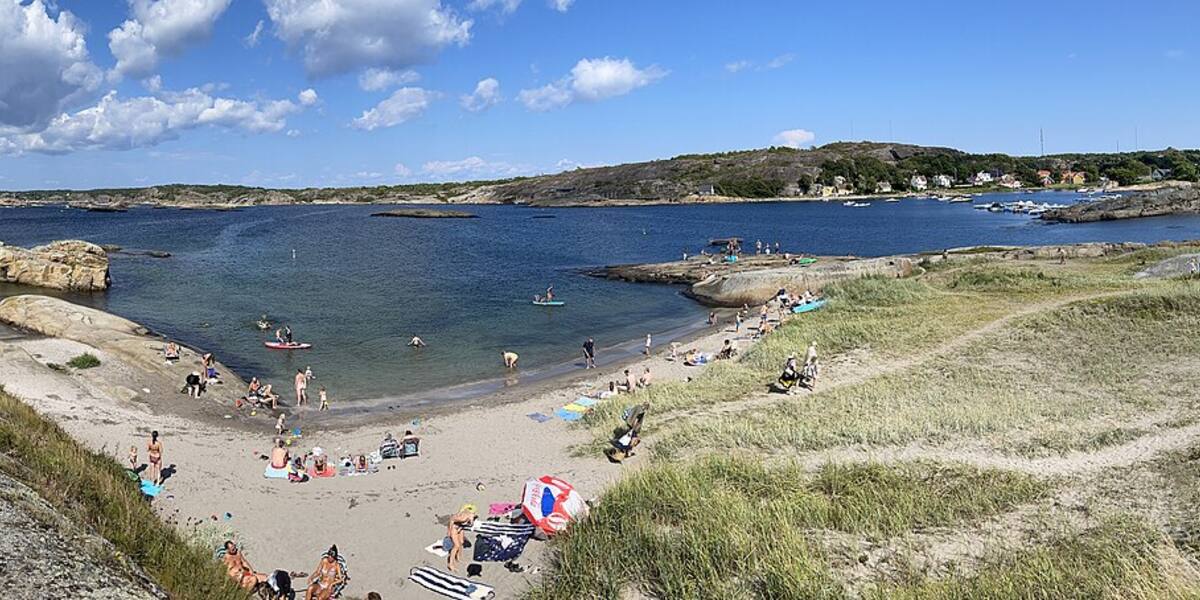
Photo: Wolfmann·CC BY-SA 4.0· Wikimedia Commons
Islands / Færder / Tjøme
The classic summer island in southern Færder, joined to Nøtterøy by Vrengenbrua (1932/1981). It became a popular seaside resort around 1900. Known for Verdens Ende with its tipping beacon, beaches such as Mostranda, and a skerry belt of some 475 smaller islands and islets.
Tjøme covers 24.5 km² and measures about 12 km from end to end, with several hundred islets around it. Coming from the south you see Verdens Ende at the outer end, with its tipping beacon (*vippefyr*) on a stone cairn. To the north, Vrengenbrua ties Tjøme to Nøtterøy. Bathing coves, smooth rock and cabin plots crowd the shoreline the whole way round.
Road bridge from Nøtterøy (Vrengenbrua).
The island is connected by road, so you need neither a boat nor a timetable.
Tjøme lived off fishing and seafaring for a long time. Around 1900 holidaymakers from Kristiania found their way here, and Tjøme became a popular seaside resort. In the 1930s, 25 guesthouses were operating at the same time, and tourism turned a coastal parish into a holiday place.
The link to the mainland long went across Vrengen by cable ferry, built around 1900. A suspension bridge over the sound followed in 1932, replaced in 1981 by the present concrete bridge, 465 metres long and 27 metres high.
Verdens Ende, at the outer tip, got its tipping beacon in 1934. It reconstructs an old type of light in which a basket of burning coal was levered up on a beam. Tjøme was a municipality in its own right from 1837 until 1 January 2018, when it became part of Færder.
Tjøme has around 2,900 year-round residents. In summer the island fills with cabin owners and visitors, an estimated 40,000 people at peak. Verdens Ende is one of the most visited destinations in Vestfold, with the Færder National Park centre next to it. There are beaches such as Mostranda, plenty of guest harbours and a busy summer life along the shore. The skerries south and east of Tjøme, hundreds of islets, are part of Færder National Park.
You reach Tjøme by car over Vrengenbrua from Nøtterøy, with no ferry involved. There are guest harbours at Verdens Ende and several other points around the island. Your own boat can tie up in the coves or anchor off. Verdens Ende has a quay and food service in season. Protection: the outer islets and skerries lie within Færder National Park, established 23 August 2013. Several are seabird reserves closed to access from 15 April to 15 July. Keep well clear of the marked reserve islets in the breeding season. Tjøme itself is open under the right to roam (*allemannsretten*).
The 1934 tipping beacon at Verdens Ende copies an older kind of light. A basket of burning coal was levered up on a long beam like a balance arm, high enough for sailors to see. The fire is out, but the structure stands and has become the emblem of Tjøme.
Twenty-five guesthouses ran on Tjøme at once in the 1930s. Summer guests came from the capital by boat and stayed the whole season, a different kind of holiday from today's cabin weekends.
The Vrengen crossing has taken three forms in a century: a cable ferry around 1900, a suspension bridge in 1932, a concrete bridge in 1981. Each rebuild tracks how much car traffic Tjøme had come to carry.
Oslo Sea Experience passes Tjøme on its private fjord trips from Tjuvholmen.
The Norwegian version notes which facts were taken from each source: Tjøme på norsk.