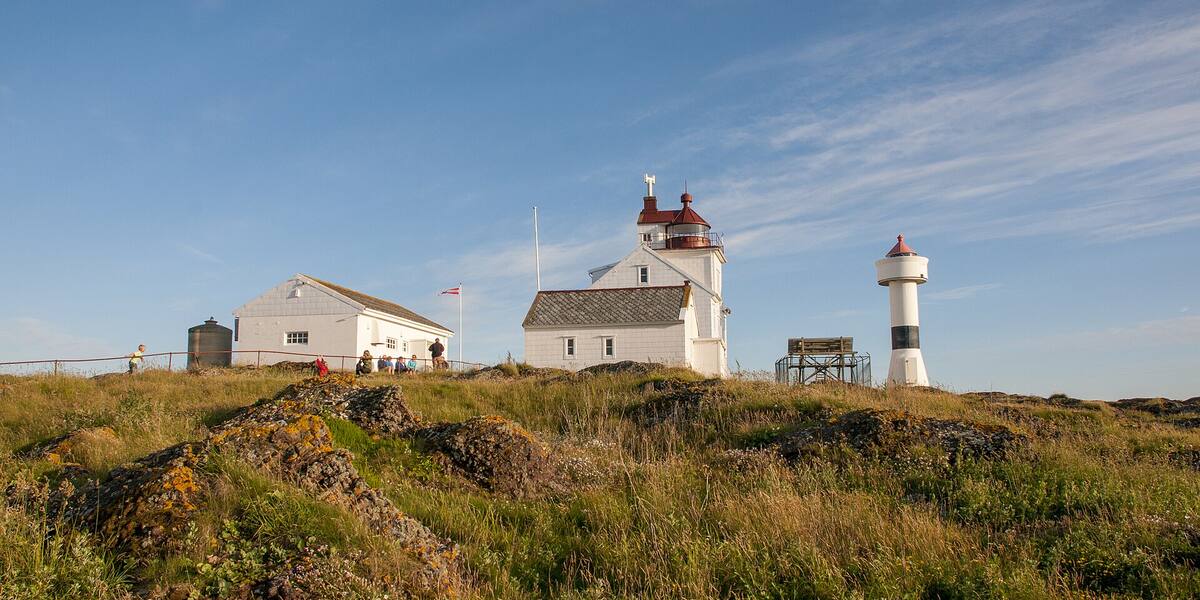
Photo: Kyrre·CC BY-SA 3.0· Wikimedia Commons
Islands / Fredrikstad / Struten
Small islet at the outer edge of the approach, with Struten lighthouse on it. The lighthouse was built in timber in 1907, after the barque Sir John Lawrence was wrecked here in 1904 with 13 lives lost, and it was automated in 1985. Three German gun emplacements from the Second World War remain around the lighthouse.
Struten is the small islet at the outer edge of the approach to Fredrikstad, with the white timber lighthouse as its landmark. The lighthouse stands 18.8 metres high, with the lantern room on top of the building itself. Three old German gun emplacements from the war surround it, and none of them was ever used.
Part of Kystled Oslofjorden. See all the coastal trail cabins.
Coastal trail cabin (accommodation via Oslofjordens Friluftsråd) or private boat.
No scheduled boat comes here. You will have to find the nearest public quay yourself, and the rest is your own boat or a kayak. Check the wind and wave forecast before you set out. The open stretches in the outer fjord turn unpleasant in a fresh breeze.
The lighthouse was built in 1907, a timber structure with a small lantern room on top of the house. Behind it lay a shipwreck: in 1904 the barque Sir John Lawrence ran aground and was wrecked at Struten, and all 13 on board died. The wreck moved the authorities to approve one here. An application had been turned down as far back as 1886.
During the Second World War the Germans built three gun emplacements around the lighthouse. They were never brought into use.
The lighthouse was automated in 1985. The light was then moved to a mast southwest of the original building, and the station was left unstaffed.
Struten is part of the coastal trail system and offers accommodation. The lighthouse building is a coastal trail cabin (*kystledhytte*) run through Oslofjordens Friluftsråd, the regional outdoor recreation council. Exposed out at the outer edge of the shipping lane, Struten is a popular destination for boat people and kayakers.
Struten is reached by private boat or kayak. Accommodation in the cabin is booked through Oslofjordens Friluftsråd, where you can also check the season and availability. Landing is at the islet's quay. The spot is exposed, and weather and swell can make coming alongside demanding. No general protection regulation is known for the islet.
The lighthouse was built because 13 men drowned. The authorities said no to a lighthouse in 1886 and changed their minds after Sir John Lawrence went down in 1904.
The three German gun emplacements around the lighthouse were never used. The concrete shells are still there, from an invasion that never came this way.
You can sleep in the lighthouse building itself. Automation in 1985 freed up the keeper's quarters, and it became a coastal trail cabin.
Oslo Sea Experience passes Struten on its private fjord trips from Tjuvholmen.
The Norwegian version notes which facts were taken from each source: Struten på norsk.