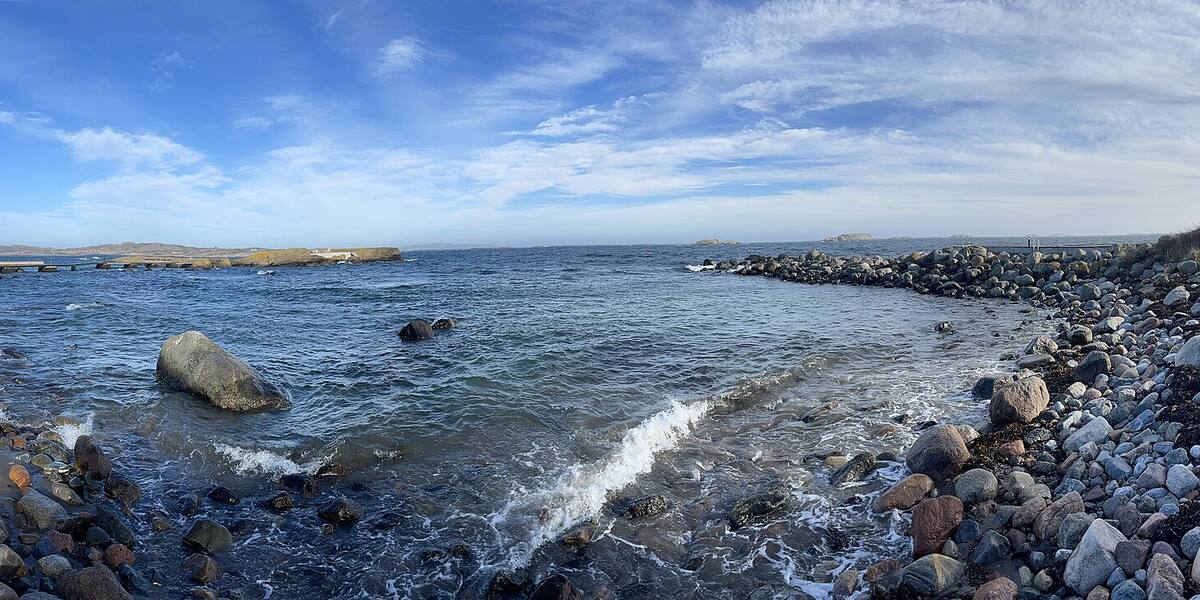
Photo: Wolfmann·CC BY-SA 4.0· Wikimedia Commons
Islands / Færder / Sandø
An island by Hvasser, separated from the village by Sandøsund. It is singled out as important for its flora and insect fauna, and forms part of Færder National Park.
Sandø lies just east of Hvasser, separated from the village by the narrow Sandøsund. Sandøbukta is a good harbour and a busy bathing bay on a summer day. The sand beaches are the island's signature. Sandø is on the Tjøme–Hvaler Ra, and that is where the sand comes from.
Færder National Park. The boundaries and the rules are in Naturbase, and they are worth checking before you land anywhere outside the marked areas.
Private boat or kayak.
No scheduled boat comes here. You will have to find the nearest public quay yourself, and the rest is your own boat or a kayak. Check the wind and wave forecast before you set out. The open stretches in the outer fjord turn unpleasant in a fresh breeze.
The sand came with the ice. The terminal moraine left behind around 12,000 years ago gave the island fine-grained sand and rounded stones. That is unusual in an archipelago that is otherwise bare, ice-scoured rock. In the late 1800s the place drew painters. Christian Krohg painted *Hardt le* here in 1882. Eilif Peterssen painted Sandø in 1894 and 1899, and both Jean Heiberg and Carl von Hanno worked in the area.
The island had permanent settlement and smallholdings. From the early 1900s it has been inhabited only in season. Sandø was given protected status in the 1950s.
Sandø is uninhabited day to day, with cabins and seasonal use. Sandøbukta fills up in July.
Sandø is reached by private boat or kayak. Sandøbukta gives good anchorage for small boats. The island is part of the Ormø-Færder landscape protection area (royal decree of 30 June 2006) and, from 2013, of Færder National Park. The usual conservation rules apply, with a ban on open fires and care for the vegetation. Check Naturbase, the national database of protected areas, for any bird protection on the nearby islets.
Christian Krohg put Sandø on canvas in 1882 with *Hardt le*. The island was a destination for painters before it was a swimming spot.
The beaches exist because the ice left a moraine here, the Tjøme–Hvaler Ra, while the neighbouring rock was scraped bare.
Oslo Sea Experience passes Sandø on its private fjord trips from Tjuvholmen.
The Norwegian version notes which facts were taken from each source: Sandø på norsk.