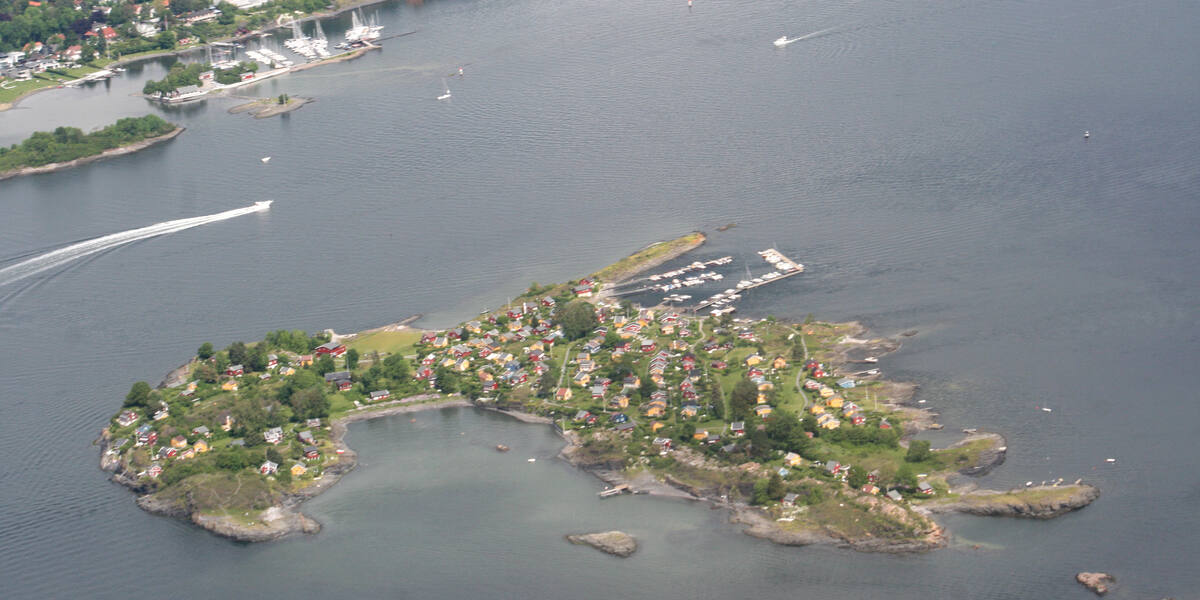
Photo: GAD·CC BY-SA 4.0· Wikimedia Commons
Islands / Oslo / Nakkholmen
State-owned island about 600 m off Bygdøy, densely built with small cabins from the 1920s. There are 182 of them, and their size, colour and appearance are tightly regulated. A shipyard ran here from 1918 to 1952. Open to public access and outdoor recreation.
Nakkholmen lies around 600 metres off Bygdøy, a small island packed with little cabins. From the water you see them between the pines, with smooth glacier-polished rock facing west. There are fossils in the rock at the waterline on the west side. It has had a shipyard, a telegraph station and cabin life side by side.
A 25-dekar stretch of coast with fossils, protected as a natural monument in 1988 and upgraded to a nature reserve in 2008. The boundaries and the rules are in Naturbase, and they are worth checking before you land anywhere outside the marked areas.
Year-round ferry from Rådhusbrygge 4.
Times shift with the season, and several of the island boats run only in summer. Check the current timetable at Ruter.
Nakkholmen is 0.145 square kilometres, owned by the state and managed by Statsbygg, the state property agency. During the Napoleonic Wars an optical telegraph station was built here in 1809, to warn of enemy ships coming up the fjord. From 1823 the state leased the island out in ten-year terms.
A shipyard operated on the island from 1918 to 1952. Cabin building got going once it was permitted in 1923, and there are 182 small cabins there today, under strict rules for size, colour and appearance. Nobody lives on the island permanently.
The rock face to the west is a fossil site. A 25-dekar (2.5-hectare) stretch of coast was protected as a natural monument in 1988 and turned into a nature reserve in 2008.
Nakkholmen is a cabin island with no permanent residents, open to public access and outdoor recreation. People come for the smooth rock and the swimming, and one of the coves goes by the nickname "blue lagoon". The cabins are holiday properties, low and tightly regulated, much as on the neighbouring islands Lindøya and Bleikøya.
A year-round ferry runs from Rådhusbrygga, the City Hall quay in Oslo. Check the current timetable from Ruter, the regional public transport operator. Summer and winter differ. Private boats and kayaks can land at the rock shelves and anchor in the coves. The swimming spots and the rocks are open to everyone; the cabins and their plots are private. The 25-dekar nature reserve covers the fossil rock on the west side, where the fossils are protected and nothing is to be chipped loose. Check Naturbase, the national database of protected areas, for the current reserve boundary before going ashore away from the prepared spots.
Long before the cabins, an optical telegraph stood here, built in 1809 to relay word of enemy ships heading for Akershus during the Napoleonic Wars.
Nakkholmen had a shipyard for more than thirty years, from 1918 to 1952, before it became purely a cabin island.
The rock to the west is full of fossils, and a whole stretch of coast is protected for that reason, a reserve since 2008.
The cabins are regulated so tightly on colour and size that the island has kept the same low, uniform look since the 1920s.
Oslo Sea Experience passes Nakkholmen on its private fjord trips from Tjuvholmen.
The Norwegian version notes which facts were taken from each source: Nakkholmen på norsk.