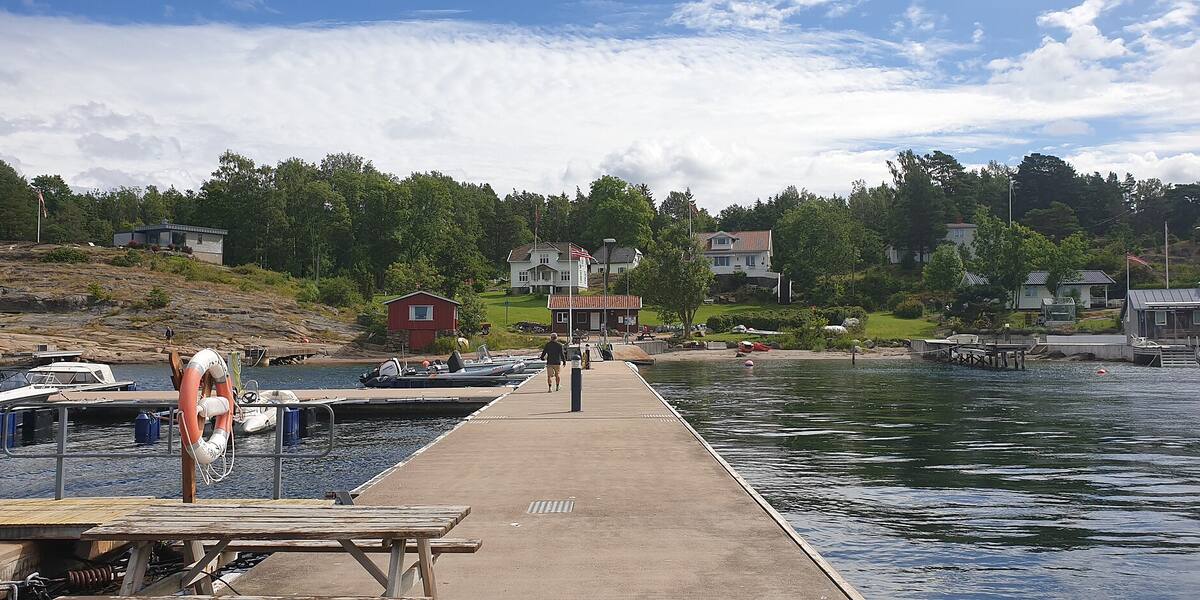
Photo: PeterFisk·CC BY-SA 4.0· Wikimedia Commons
Munch here 1887
Edvard Munch was 23 the summers he spent on Veierland, in the years before his breakthrough. The same Swiss-style villa later housed both Ole Paus and Jens Bjørneboe, and the island has kept what they came for: a car-free community with medieval roots.
The oldest farms on Veierland appear in written sources from the Middle Ages, and the name comes from Old Norse Vájir, plural of vá, «corner or bend». The island lay under Stokke municipality until 1 January 1965, when it was transferred to Nøtterøy at the residents' own wish. The church, a chapel under Torød parish, was raised in 1905, and the community hall came in 1956.
Artists found the island early. Edvard Munch spent the summer of 1887 here, probably 1888 as well, 23 years old and in the years before his breakthrough. Later, two well-known names came to the same house: the singer Ole Paus owned the Swiss-style villa Eikvold from 1972 to 1974 and wrote a song about the island, and Jens Bjørneboe lived his final year in the same villa. He died there on 9 May 1976.
The island community has also known the pressure every small island community knows. A residency requirement was introduced in 1998 and lifted on 19 June 2012, against the residents' wishes, and the school closed in 2013. The island is car-free, and goods and furniture travel by tractor and trailer from the quay. The boat from Tenvik runs all year.
Access, protection and live departures stand on the island page: Veierland.
Every fact in this piece is drawn from the island dossier behind the island page, and these are its sources.