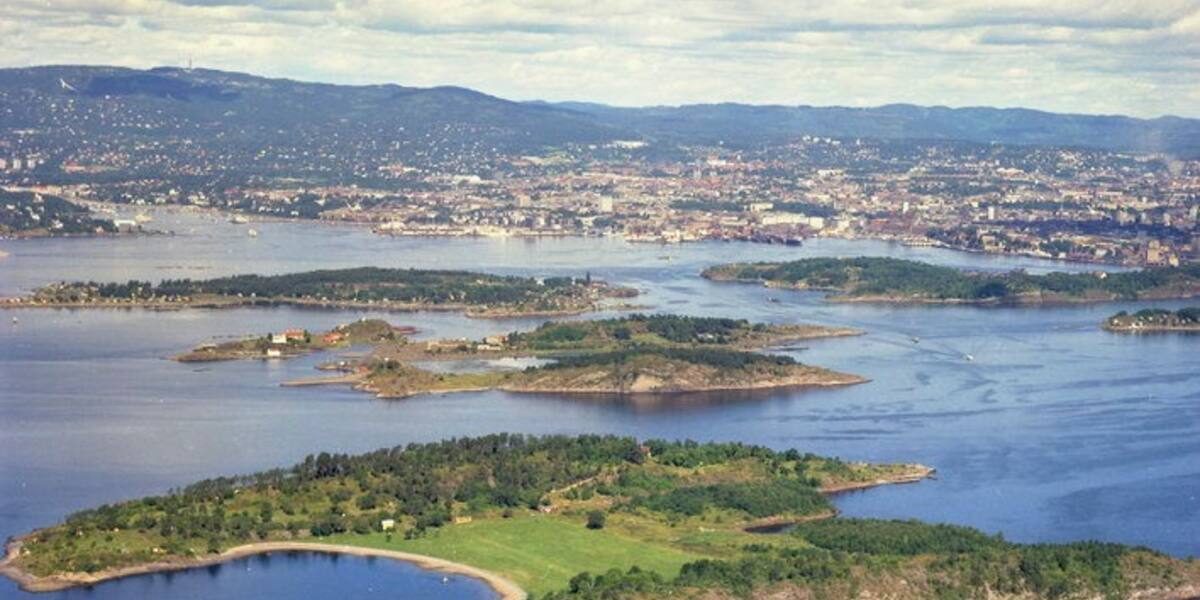
Photo: Halvor Pritzlaff Njerve, Oslo kommune / Bymiljøetaten·Fri bruksrett· Oslo kommunes mediebank
Landfill 1904–1949
Under the grass where visitors barbecue lie more than 45 years of Oslo's household waste. The story of Langøyene is how two islands became one, and how a beach became a 304-million-kroner cleanup.
Industry came early to these islands. Norway's first cement works ran on Nordre Langøya from 1837 to 1938, using limestone fetched from Malmøya. But what shaped Langøyene as it lies today was something far less dignified: the city's waste.
In 1899 Kristiania rejected Nakholmen as a dumping ground, and in 1900 Langøyene emerged as the alternative. The purchase went through in 1902, over protests from Nesodden. From 1904 the city tipped its refuse here, and from 1908 the sound between the two islands became the main receiving ground. The waste arrived on flat-bottomed barges with hinged floors, loaded with up to 70 tonnes, and some thirty men spread it with wheelbarrow and spade. In 1910 wrecks were sunk at both ends of the sound to hold the refuse in place, and in 1922 came cranes that lifted up to three tonnes a grab.
The sound that divided the islands no longer exists. It was filled in, and two islands became one. Closure was decided in 1938, but the German occupation force resumed the dumping after the last ordinary load on 8 April 1940. The very last load came in 1949.
In 1952 the island opened as a bathing beach, with sand driven in on top of the fill. That held for sixty years. In 2013 old waste surfaced, and samples showed raised levels of lead and mercury. Oslo's city council granted 304 million kroner for a cleanup, carried out from autumn 2019 to spring 2021: the old landfill was capped with 360,000 tonnes of mass, and the north side got erosion protection.
The island belongs to Nesodden municipality but is owned and run by Oslo, an arrangement Nesodden protested at the sale in 1902. So it remains: formally theirs, and Oslo decides.
Access, protection and live departures stand on the island page: Langøyene.
Every fact in this piece is drawn from the island dossier behind the island page, and these are its sources.